


The infrastructure challenge in healthcare
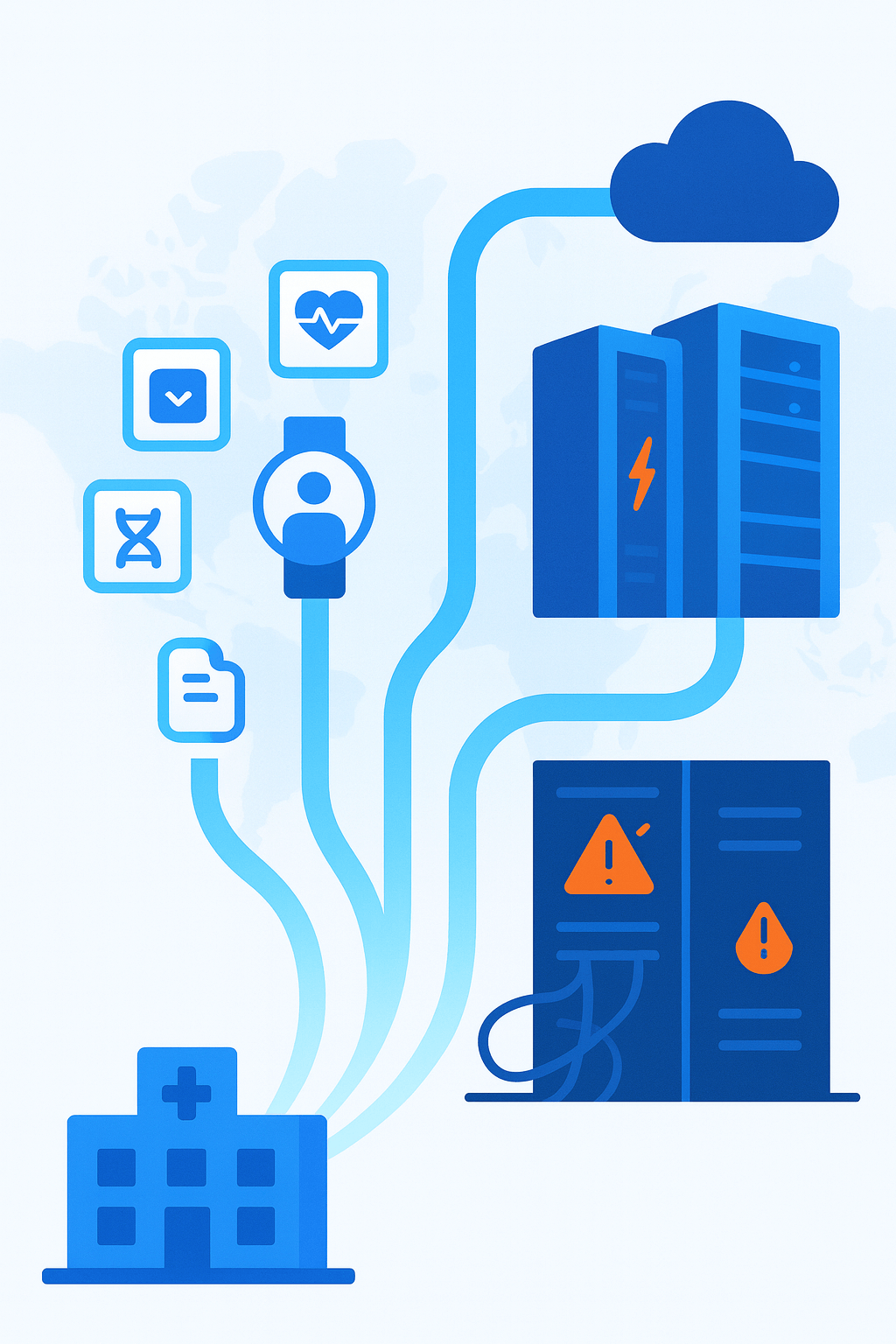
Healthcare organisations today manage an explosion of data: electronic health records (EHRs), medical imaging, telemedicine streams, IoT/wearable device feeds, genomics, AI-driven diagnostics and more. According to one source, the compound annual data-growth rate for healthcare is forecast at around 36% by 2025: significantly faster than many other sectors. Volico Data Centers+2Sttelemediagdc+2
At the same time, traditional on-premises data centres in hospitals and clinics face ageing infrastructure, limited connectivity, inefficient power/cooling and regulatory burdens. These factors create a bottleneck for innovation, cost management and resilience.
This creates a strong case for healthcare institutions to explore colocation arrangements — renting space, power, cooling and connectivity in specialist data-centre facilities rather than owning and operating everything themselves.
What colocation brings to healthcare in practical terms
Below are the key benefits of using colocation data-centres for healthcare operations:
1. Scalability and cost-efficiency
Healthcare providers benefit from being able to lease rack space or cages rather than build new large data centres. One report notes that “outsourcing data storage to a data centre colocation service provider can enable healthcare facilities to leverage additional space and the capacity needed to meet their growing data-storage demands.” Volico Data Centers+2Jalasoft+2
By shifting from heavy capital expenditure (CapEx) to more predictable operating expenditure (OpEx), organisations can allocate more resources toward patient care, innovation or clinical research.
2. Reliability, uptime & operational resilience
Healthcare services cannot tolerate downtime—patient care, diagnostics, telemedicine all depend on consistent access to infrastructure. A colocation provider often offers redundant power, cooling, network paths and strict SLAs. For example, one article points out that many healthcare organisations lack the cooling, UPS backup and infrastructure to ensure 100% uptime in-house. Volico Data Centers+2Sttelemediagdc+2
Leveraging a vetted colocation facility reduces infrastructure risk.
3. Regulatory compliance and data security
Patient data (ePHI) is highly sensitive and subject to stringent regulation (HIPAA in the US, GDPR in Europe, etc.). Colocation facilities focused on healthcare will provide tailored compliance services, secure cages, audit logs, physical and logical access controls. According to one analysis, “A colocation provider’s role … is to supply HIPAA-compliant colocation services that are scalable, modular and suited to the unique specifications of companies across the care continuum.” Silverback Data Center Solutions+1
Thus, healthcare IT teams can reduce burden of facility compliance and focus more on their core domain.
4. Connectivity & hybrid infrastructure enablement
Colocation data-centres typically provide high-quality connectivity, meet-me rooms, direct carrier links, interconnection to cloud and hybrid infrastructure. For healthcare, this means quicker access to cloud analytics, telemedicine services, and mobile/IoT device data. One piece highlights how healthcare organisations are implementing hybrid IT (cloud + colocation + on-prem) to modernise operations. CoreSite+1
Access to a carrier-neutral, high-throughput facility supports next-gen healthcare services.
5. Support for innovation: AI, imaging, analytics
Healthcare is embracing AI-driven diagnosis, large-scale imaging, genomics and advanced analytics. These workloads demand high I/O, low latency, large storage and compute capacity. The “data-centre innovations for healthcare” report notes the role of modular units and AI-driven infrastructure to support this trend. DataBank | Data Center Evolved
A colocation platform gives healthcare organisations a ready infrastructure layer to deploy these advanced workloads without building everything themselves.
Why Choose Us
- Access to 30+ providers across North America – and worldwide
- We don’t charge for referrals
- Our system will send you only qualified providers with trusted reputations


Get A Quote
Describe your needs and we will be in touch shortly with additional details and pricing information.
Use-cases where colocation delivers clear value in healthcare
Here are specific scenarios in which healthcare institutions can extract tangible benefit:
Key evaluation criteria for healthcare organisations
Before selecting a colocation partner, healthcare IT & executives should assess:
Facility’s certifications & compliance readiness:
Does the provider support healthcare-relevant frameworks (HIPAA, HITECH in the US; ISO 27001, HITRUST) and provide audit documentation?
Connectivity architecture & latency:
Look at carrier-neutral status, number of network/peer options, edge/metro proximity, cross-connect costs.
Scalability & modularity:
Can the provider support growth in rack space, power density, compute/storage for future AI/imaging workloads? Does the contract allow expansion seamlessly?
Security (physical + logical):
Biometric access, CCTV, secure cages, monitoring, encryption options, remote-hands service levels.
Operational resilience:
Uptime SLAs, redundant power/cooling, geographic diversity, remote-hands support, disaster-recovery options.
Hybrid cloud support & ecosystem:
Does the facility support cloud-on-ramps, private-cloud interconnect, edge/IoT deployments? Many healthcare innovations depend on hybrid models.
Cost transparency & business case:
Understand power usage (PUE), cooling, space cost, connectivity, remote-hands. Quantify TCO vs owning in-house.
Governance & exit strategy:
Ensure contract covers data-ownership, migration support, audit rights, regulatory continuity, exit from colocation if needed.
Strategic caveats and risk considerations
Migration complexity
The move from on-premises to colocation (or hybrid) must be carefully planned: data migration, application dependencies, regulatory review.
Vendor lock-in risk
Ensure the partner supports multi-vendor, open interconnect; avoid constraints that hamper future flexibility.
Power/sustainability constraints
Given healthcare’s critical nature, confirm provider’s roadmap for capacity growth, cooling efficiency, and sustainability.
Control trade-offs
While you outsource facility infrastructure, your organisation retains responsibility for data, applications and compliance: governance must reflect that.
Regulatory/data-residency risk
Especially across regions the provider must support relevant jurisdictional data-residency and privacy regulations.
Edge vs central-facility balance
Some workloads may need closer proximity (edge) rather than central data-centre to meet latency/regional needs; colocation strategy needs to account for this.
Conclusion
For healthcare organisations today, whether hospital systems, clinical research networks, telemedicine providers or biopharma collaborations colocation data-centres present a compelling infrastructure model. They offer scalability, improved reliability, compliance support, and a path to innovation without the cost and complexity of building wholly owned data centres.
Given the pace of change in healthcare (AI diagnostics, digital health, remote care, large-scale data), infrastructure must be agile, resilient and secure. Colocation hosting becomes a strategic asset, not just a cost-saving move. The organisations that treat infrastructure as enabler rather than burden will gain operational advantage and future-proof their IT stack.


