


The data center industry is experiencing a seismic shift. In today’s digital landscape, data centers serve as the backbone of our connected world, powering everything from cloud services to artificial intelligence applications.
Understanding the different types of data centers—particularly hyperscale data center and colocation data center models—is no longer optional for enterprise decision-makers. This comprehensive guide cuts through the complexity, revealing the key differences between hyperscale and colocation facilities and helping you determine which data center model delivers maximum value for your organization.
Why this matters now: Data processing demands are skyrocketing, AI workloads are reshaping infrastructure requirements, and choosing the wrong data center strategy can cost millions in lost efficiency and opportunity.
What Are the Main Types of Data Centers in Today’s Market?
Three dominant models control today’s data center landscape, each engineered for specific organizational needs and workload requirements. Understanding these differences determines infrastructure success or failure.
Hyperscale data centers represent the titans of the industry. These massive facilities support extraordinary scalability, housing thousands of servers across hundreds of thousands of square feet. Companies like Microsoft and other cloud service providers own and operate these behemoths, delivering the computing backbone for global digital services.
Colocation data centers offer the goldilocks solution. Multiple organizations rent space within shared facilities, accessing professional-grade infrastructure without massive capital investment. These data center facilities provide power and cooling, connectivity, and security services while allowing businesses to maintain control over their own servers and equipment.
Enterprise data centers serve organizations demanding complete control. These private facilities are owned and operated by individual companies requiring absolute authority over their data center infrastructure, typically driven by strict compliance requirements or highly sensitive data processing needs.
The reality: Most successful organizations use a hybrid approach, combining multiple data center types to optimize cost, performance, and control across different workloads.
How Do Hyperscale Data Centers Differ from Traditional Data Centers?
Scale changes everything. Hyperscale data centers operate at unprecedented levels that fundamentally transform the economics and capabilities of data processing.
The size advantage is staggering. While traditional data centers might house hundreds of servers, hyperscale facilities manage thousands of servers in configurations optimized for maximum efficiency. These facilities are typically located in areas with abundant, low-cost power and favorable climates that slash cooling costs.
Automation drives hyperscale superiority. Advanced software-defined infrastructure and standardized hardware configurations create economies of scale impossible in smaller facilities. This standardization allows hyperscale operators to deploy identical configurations across multiple global locations, dramatically reducing complexity and operational costs.
Cost advantages compound at scale. Hyperscale operators negotiate superior rates for power, connectivity, and services. This economic leverage, combined with operational efficiency, enables competitive cloud services pricing while maintaining healthy margins.
Key insight: Hyperscale data centers are built for elastic scalability, supporting massive volumes of data and big data analytics workloads that would overwhelm traditional infrastructure.
What Are Colocation Services and How Do They Work?
Colocation delivers enterprise-grade infrastructure without enterprise-level investment. This model provides professional data center services while allowing organizations to maintain physical control over their critical equipment.
Retail colocation dominates the market. Businesses lease individual racks, cages, or private suites within shared facilities. Organizations maintain complete control over their servers and equipment while the colocation provider supplies facility infrastructure, power and cooling, security, and network connectivity. This approach eliminates infrastructure overhead while preserving operational control.
Wholesale colocation serves larger requirements. Organizations lease entire rooms or floors within data center facilities, often preferred by larger enterprises or companies with substantial infrastructure needs. Wholesale arrangements typically offer superior economics for organizations requiring significant space and power allocation.
Connectivity becomes a competitive advantage. Colocation facilities provide access to multiple network carriers and internet exchange points, delivering superior connectivity options compared to most on-premises solutions. This connectivity diversity, combined with shared cost structures, makes colocation attractive for businesses requiring reliable, high-performance data center services.
The colocation value proposition: Professional infrastructure, predictable costs, and operational flexibility without the burden of facility management.
Enterprise Data Centers: When Does Private Infrastructure Make Sense?
Complete control comes at a premium. Enterprise data centers represent the traditional model where organizations build and operate private facilities, offering absolute authority over security, compliance, and operational procedures.
Regulatory compliance drives enterprise decisions. Organizations in highly regulated industries—financial services, healthcare, government—often require private data centers to maintain control over critical data and ensure compliance with industry-specific regulations. When regulatory requirements outweigh cost considerations, enterprise data centers become necessary.
Predictable workloads justify private investment. Companies with stable, consistent computing demands may find dedicated infrastructure more cost-effective than external services. Organizations with significant existing data center investments often prefer upgrading current facilities rather than migrating to external providers.
The enterprise reality check: Building enterprise data centers requires substantial capital expenditure and specialized operational expertise. Organizations must invest in facility construction, power and cooling systems, security infrastructure, and dedicated staff. This investment makes sense only when specific requirements outweigh the cost advantages of shared infrastructure.
Modern enterprise strategy: Many organizations maintain core systems in private data centers while leveraging colocation or hyperscale services for non-critical workloads.
Hyperscale vs Colocation: Which Model Offers Better Scalability?
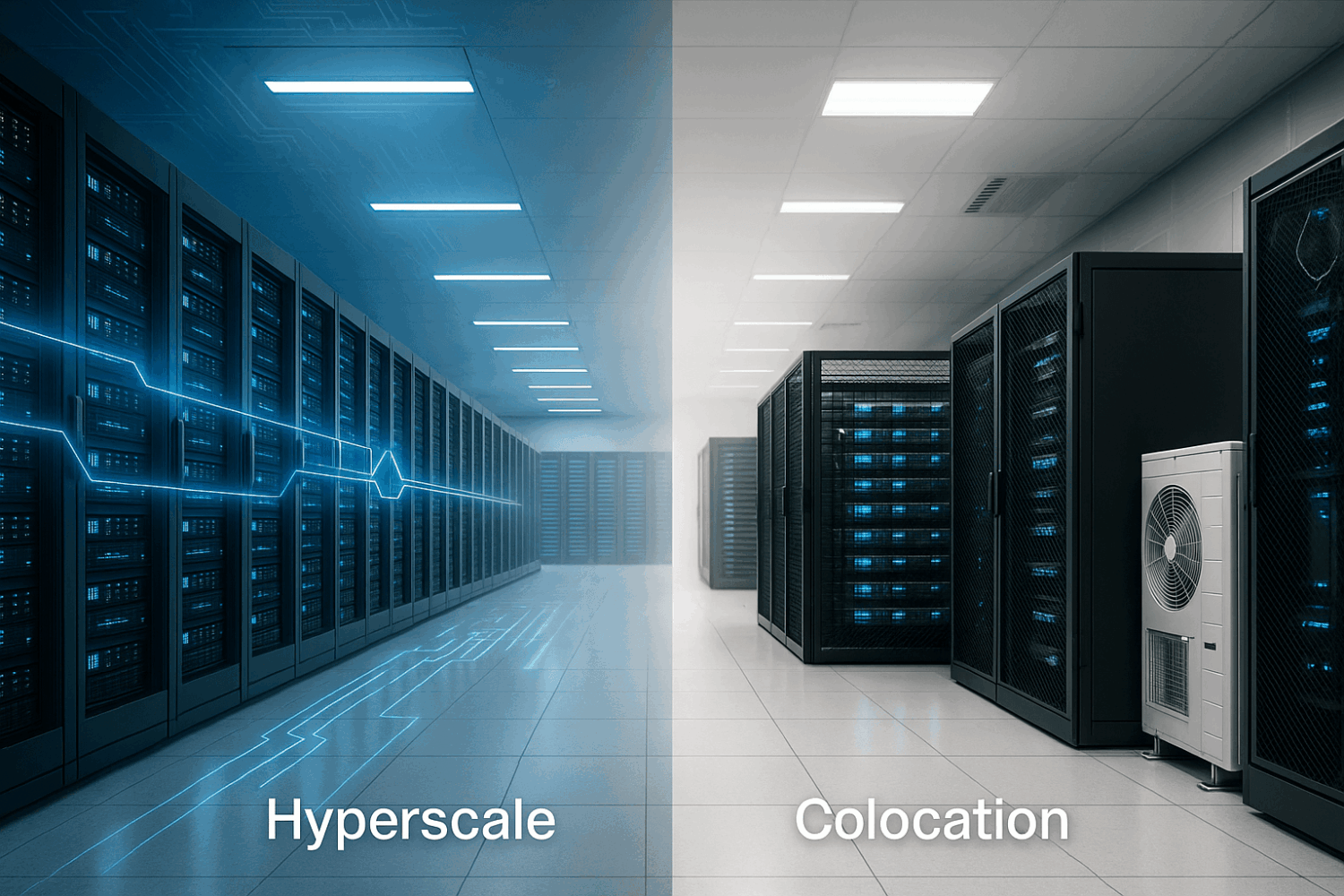
Scalability depends entirely on your organization’s growth patterns and operational preferences. Both models excel in different scenarios, making the choice highly dependent on specific business requirements.
Hyperscale delivers unlimited elastic scaling. These facilities accommodate rapid growth through software-defined infrastructure and automated systems. Organizations utilizing cloud-native architectures can scale virtually instantly with minimal upfront investment. For unpredictable, variable workloads, hyperscale offers unmatched flexibility.
Colocation provides controlled, predictable scaling. Organizations start with small footprints and gradually expand within facilities as needs grow. This approach works excellently for businesses requiring hybrid environments or specific hardware configurations unavailable through standardized cloud services.
The scalability decision matrix:
- Choose hyperscale for variable, unpredictable demands requiring elastic scaling
- Choose colocation for steady growth patterns where infrastructure control matters
- Choose hybrid for complex organizations with diverse workload requirements
Critical insight: The nature of your workload—not just its size—determines the optimal scalability approach.
What Are the Cost Differences Between Hyperscale and Colocation?
Understanding cost structures determines long-term financial success. Both models offer advantages depending on usage patterns, scale, and organizational requirements.
Hyperscale operates on consumption-based pricing. Organizations pay only for resources actually consumed, making this model highly cost-effective for variable workloads or organizations beginning digital transformation. However, costs escalate rapidly for consistent, high-volume usage, particularly data-intensive applications requiring significant bandwidth or storage.
Colocation offers predictable, fixed pricing. Monthly fees for space, power, and services provide superior cost predictability. This model proves more economical for organizations with stable, consistent infrastructure needs. The ability to rent space and deploy owned equipment often results in lower long-term costs compared to ongoing cloud service fees.
The break-even calculation: Most enterprises find optimal cost efficiency through hybrid approaches—using colocation for predictable workloads and hyperscale for variable or peak demands.
Cost optimization strategies:
- Analyze usage patterns to identify predictable vs. variable workloads
- Calculate total cost of ownership over 3-5 year periods
- Consider data transfer costs which can be substantial in hyperscale models
- Factor in operational overhead for each model
Edge Data Centers: The Future of Distributed Computing
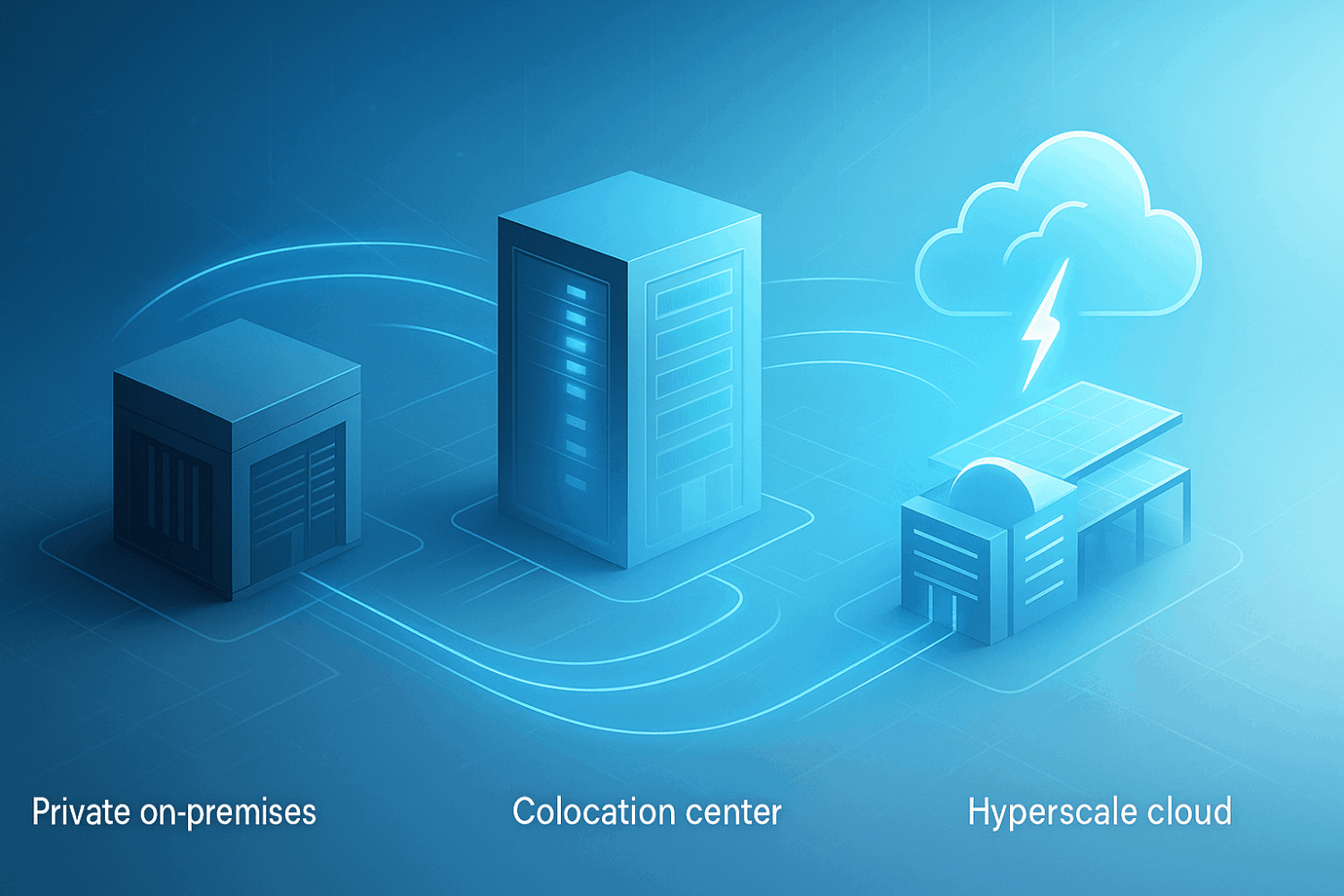
Edge computing is reshaping the entire data center landscape. These smaller facilities bring processing power closer to users and devices, addressing latency requirements that centralized facilities cannot meet.
Artificial intelligence drives edge adoption. AI applications, Internet of Things devices, and real-time applications require sub-millisecond response times impossible with traditional centralized processing. Edge data centers solve this latency challenge while maintaining connections to larger facilities for heavy computational tasks.
Edge facilities utilize hybrid principles. These centers combine hyperscale standardization with colocation flexibility, offering professional infrastructure with local presence. Most edge deployments connect back to larger hyperscale or colocation data centers, creating distributed architectures that optimize both performance and cost.
The edge opportunity: Organizations can deploy infrastructure closer to users while maintaining centralized resources for complex processing. This distributed approach is becoming essential for AI workloads, autonomous systems, and real-time analytics.
Strategic consideration: Edge data centers represent the next evolution in distributed computing, creating new opportunities for performance optimization and user experience enhancement.
Security and Compliance: How Do Different Data Center Types Compare?
Security and compliance requirements often determine data center selection. Each model offers distinct advantages and challenges that organizations must carefully evaluate.
Hyperscale providers implement enterprise-grade security with robust measures and compliance with major industry standards. However, organizations operate under shared responsibility models, relying on provider security controls with limited visibility into specific implementations. This approach works well when provider security exceeds internal capabilities.
Colocation offers balanced security control. Providers handle physical security, facility access, and environmental protections while tenants control equipment and data security. This model allows organizations to implement custom security protocols while benefiting from professional facility security.
Enterprise data centers provide complete security authority but require organizations to develop and maintain comprehensive security programs independently. This level of control is essential for organizations with specific security requirements or those operating in highly regulated environments.
Security decision framework:
- Evaluate your security requirements against provider capabilities
- Assess compliance obligations and how each model addresses them
- Consider security expertise available within your organization
- Analyze risk tolerance for shared vs. dedicated security models
Choosing Between Hyperscale and Colocation: Key Decision Factors
The choice between hyperscale and colocation hinges on several critical factors that must align with business objectives and operational constraints.
Organizational capabilities significantly influence optimal models. Larger enterprises with dedicated IT teams often benefit from colocation’s control and customization options, while smaller organizations may find hyperscale services more manageable and cost-effective. Your team’s technical expertise directly impacts which model delivers better results.
Workload characteristics determine infrastructure fit. Applications with predictable resource requirements and specific performance needs often excel in colocation environments where organizations can optimize configurations. Variable or seasonal workloads typically benefit from hyperscale’s elastic scaling capabilities.
Data sensitivity and regulatory requirements may limit options. Companies handling highly sensitive data or operating in strictly regulated industries often require the control and transparency offered by colocation or private data centers.
Decision framework:
- Assess current and projected workload patterns
- Evaluate internal technical capabilities and preferences
- Analyze regulatory and compliance requirements
- Calculate total cost of ownership for each model
- Consider hybrid approaches for complex requirements
Future Trends: How AI is Reshaping Data Center Requirements
Artificial intelligence is fundamentally transforming data center infrastructure requirements. These changes affect both hyperscale and colocation facilities as they adapt to support intensive AI workloads.
AI demands specialized hardware configurations. Applications typically require graphics processing units (GPUs) and custom accelerators often unavailable in standard hyperscale offerings. This hardware specificity drives increased interest in colocation services allowing custom deployments optimized for specific AI workloads.
Computational intensity requires advanced infrastructure. AI training and inference demand high-density computing environments with sophisticated cooling systems. Both hyperscale and colocation providers are investing heavily in new technologies supporting these intensive workloads while maintaining energy efficiency.
Edge AI creates distributed processing requirements. Real-time AI applications need processing power close to data sources, driving development of interconnected data center ecosystems leveraging different facility types’ strengths.
AI infrastructure trends:
- Specialized hardware becoming standard requirement
- Hybrid architectures combining centralized training with distributed inference
- Energy efficiency becoming critical for AI workload sustainability
- Edge deployment expanding for real-time AI applications
Key Decision Framework: Choosing Your Optimal Data Center Strategy
Choose Hyperscale When:
- Workloads are variable or unpredictable
- Cloud-native applications dominate your environment
- Capital expenditure minimization is priority
- Global scale and availability matter most
- Internal IT resources are limited
Choose Colocation When:
- Predictable, consistent workloads define your operations
- Specific hardware or compliance requirements exist
- Cost predictability is essential
- Maintaining infrastructure control matters
- Hybrid cloud strategies are preferred
Choose Enterprise When:
- Regulatory compliance demands complete control
- Highly sensitive data requires maximum security
- Existing infrastructure investments justify continuation
- Predictable workloads support capital investment
- Internal expertise enables efficient operations
Consider Hybrid Approaches When:
- Diverse workload requirements exist
- Cost optimization across different use cases is priority
- Risk mitigation through diversification matters
- Performance optimization requires multiple strategies
- Business growth creates changing requirements
Critical Success Factors:
- Align infrastructure strategy with business objectives
- Evaluate total cost of ownership over 3-5 years
- Assess internal capabilities honestly
- Plan for future growth and technology changes
- Consider security and compliance requirements carefully
- Evaluate connectivity and latency requirements
- Factor in energy efficiency and sustainability goals
- Assess vendor lock-in risks and mitigation strategies


