


If you’re managing a business that relies on web applications, APIs, or online services, you’ve likely encountered the terms “reverse proxy” and “load balancer.” While these technologies often work together and sometimes overlap in functionality, understanding their differences is crucial for making informed infrastructure decisions that can significantly impact your application’s performance, security, and scalability.
The key difference: A reverse proxy acts as an intermediary that can perform various functions like security, caching, and SSL termination while forwarding requests to backend servers. A load balancer specifically focuses on distributing incoming traffic across multiple servers to optimize performance and ensure high availability. Think of a reverse proxy as a Swiss Army knife—versatile with multiple functions—while a load balancer is a specialized tool designed for one primary purpose: traffic distribution.
This comprehensive guide will clarify the distinctions between these technologies, help you understand when to use each, and explain how they can work together to create robust, scalable infrastructure for your business applications.
Understanding Reverse Proxies
What is a Reverse Proxy?
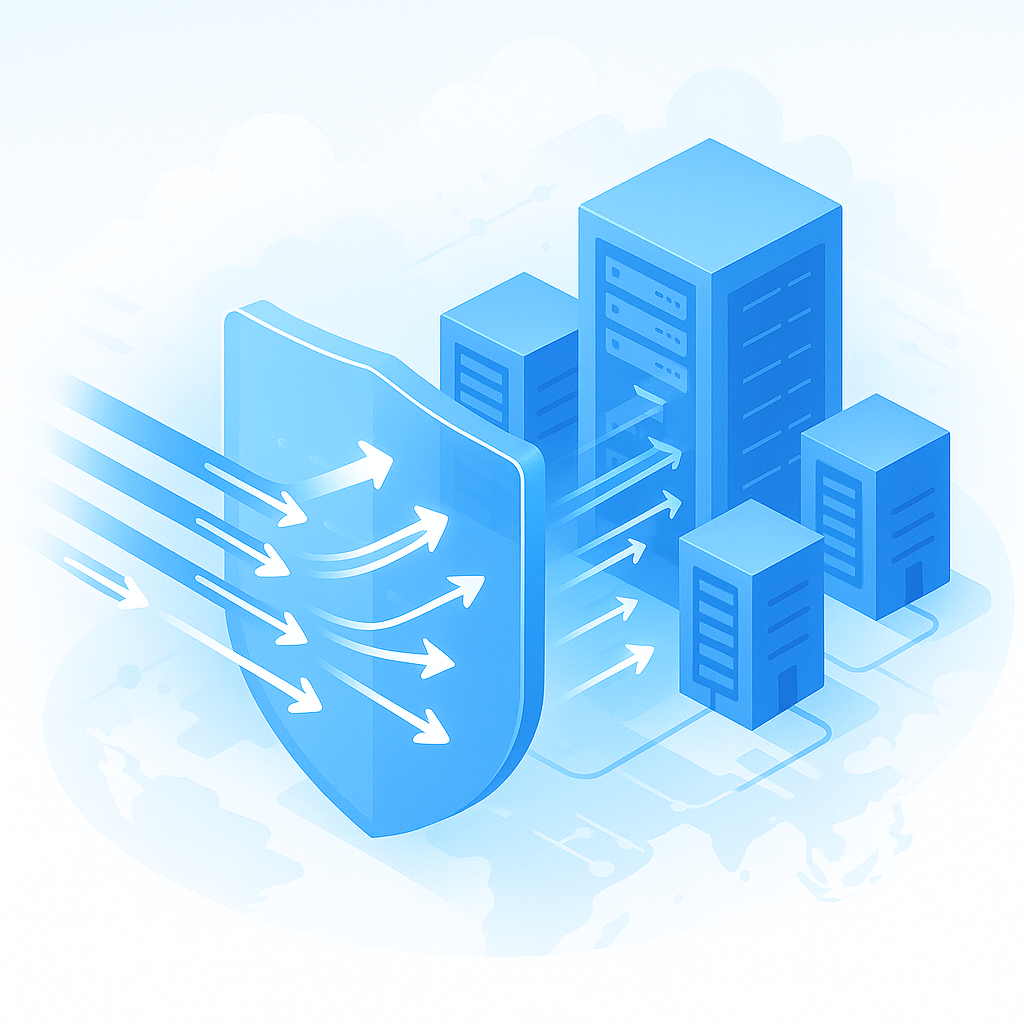
A reverse proxy is a server that sits between clients (users) and backend servers, acting as an intermediary for client requests. Unlike a forward proxy that hides client identities from servers, a reverse proxy conceals backend server details from clients. From the client’s perspective, the reverse proxy appears to be the actual web server.
How a reverse proxy works:
- Client sends request: A user requests a webpage or service
- Proxy intercepts: The reverse proxy receives the request first
- Request evaluation: The proxy analyzes the request and determines routing
- Backend communication: The proxy forwards the request to appropriate backend servers
- Response handling: The proxy receives the server response and forwards it to the client
Primary Functions of Reverse Proxies
Security Enhancement:
- IP masking: Hides backend server IP addresses from external users
- Request filtering: Blocks malicious traffic before it reaches backend servers
- DDoS protection: Absorbs and mitigates distributed denial-of-service attacks
- Web Application Firewall (WAF): Inspects and filters HTTP traffic for security threats
Performance Optimization:
- Caching: Stores frequently requested content for faster delivery
- Compression: Reduces bandwidth usage by compressing responses
- SSL termination: Handles encryption/decryption to reduce backend server load
- Content optimization: Minifies CSS, JavaScript, and optimizes images
Operational Benefits:
- Centralized management: Single point for configuration and monitoring
- Backend flexibility: Allows server changes without affecting client connections
- Protocol translation: Converts between different protocols (HTTP to HTTPS)
- Request routing: Directs requests based on content, headers, or URLs
Reverse Proxy Use Cases
Web Application Security: A financial services company uses a reverse proxy to protect customer-facing applications. The proxy terminates SSL connections, inspects all incoming traffic for threats, and forwards only legitimate requests to backend servers. This setup has reduced security incidents by 85% while improving application response times.
Content Caching and Acceleration: An e-commerce platform deploys reverse proxies to cache product images, static content, and API responses. During peak shopping periods, the proxy serves 70% of requests from cache, reducing backend server load and improving page load times by 40%.
Legacy System Integration: A healthcare organization uses reverse proxies to modernize patient portal access. The proxy adds HTTPS encryption and modern authentication to legacy systems that don’t support these features natively, enabling secure external access without modifying core applications.
Understanding Load Balancers
What is a Load Balancer?
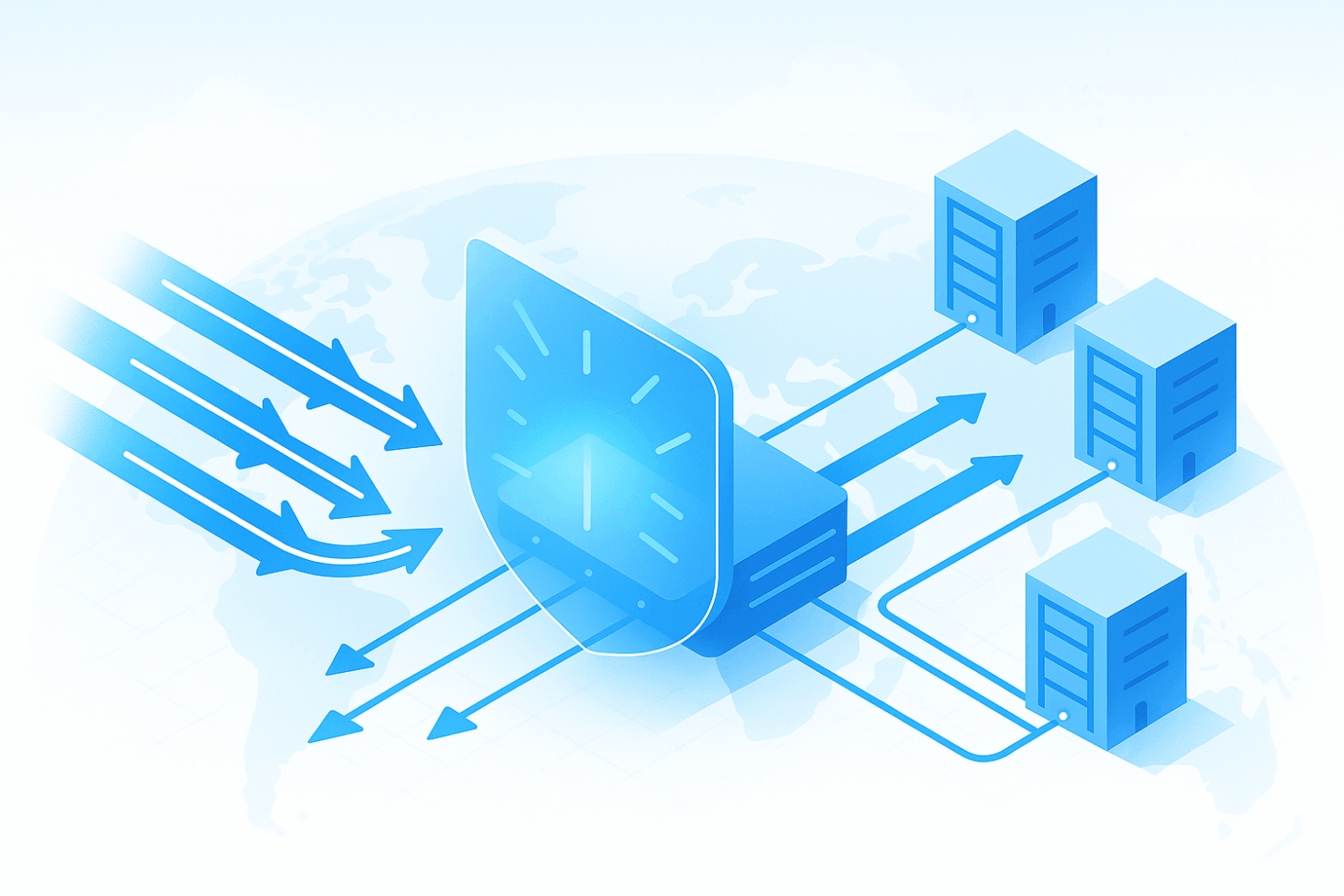
A load balancer is a device or software application that distributes incoming network traffic across multiple backend servers to ensure optimal resource utilization, minimize response times, and prevent server overload. Load balancers act as traffic cops, directing requests to the most appropriate server based on various algorithms and server health metrics.
Core load balancing process:
- Traffic reception: Load balancer receives incoming client requests
- Server selection: Algorithm determines the best available server
- Health verification: Confirms target server is operational and responsive
- Request forwarding: Sends the request to the selected server
- Response routing: Returns server response to the client
Types of Load Balancers
Layer 4 Load Balancing (Network/Transport Layer):
- Protocol focus: Operates at TCP/UDP level
- Decision criteria: Routes based on IP addresses and port numbers
- Processing speed: Fast routing with minimal packet inspection
- Use cases: High-volume applications requiring speed over advanced features
- Typical throughput: Can handle millions of requests per second
Layer 7 Load Balancing (Application Layer):
- Protocol focus: Operates at HTTP/HTTPS level
- Decision criteria: Routes based on content, URLs, headers, and cookies
- Advanced features: Content-based routing, session persistence, SSL termination
- Use cases: Complex applications requiring intelligent traffic management
- Typical throughput: Lower than Layer 4 but offers more sophisticated routing
Load Balancing Algorithms
Round Robin:
- Method: Distributes requests sequentially across servers
- Best for: Servers with similar capacity and uniform request processing times
- Advantage: Simple implementation and even distribution
- Limitation: Doesn’t consider server load or response times
Least Connections:
- Method: Routes traffic to server with fewest active connections
- Best for: Applications with varying request processing times
- Advantage: Adapts to actual server load
- Limitation: Requires connection tracking overhead
Weighted Round Robin:
- Method: Assigns different weights based on server capacity
- Best for: Mixed server environments with varying capacities
- Advantage: Accounts for server performance differences
- Limitation: Requires manual weight configuration
IP Hash:
- Method: Routes based on client IP address hash
- Best for: Applications requiring session persistence
- Advantage: Ensures consistent server assignment per client
- Limitation: May create uneven distribution with limited client IPs
Health-Based Routing:
- Method: Considers server response times and health metrics
- Best for: Dynamic environments with variable server performance
- Advantage: Optimizes performance based on real-time conditions
- Limitation: Requires comprehensive monitoring infrastructure
Load Balancer Use Cases
High-Traffic Web Applications: A social media platform uses load balancers to distribute user requests across 200+ servers. During viral content events, the system automatically scales to handle 10x normal traffic while maintaining sub-200ms response times.
E-commerce Peak Handling: An online retailer implements load balancing to manage Black Friday traffic. The system distributes shopping cart requests, payment processing, and inventory checks across dedicated server pools, maintaining 99.99% uptime during traffic spikes of 50x normal volumes.
Microservices Architecture: A streaming service uses load balancers to manage traffic between microservices handling user authentication, content recommendation, video streaming, and billing. Each service cluster has dedicated load balancing with health checks ensuring seamless failover.
Key Differences Between Reverse Proxies and Load Balancers
Functional Scope Comparison
| Aspect | Reverse Proxy | Load Balancer |
| Primary Purpose | Security, caching, SSL termination | Traffic distribution and high availability |
| Server Requirements | Can work with single server | Requires multiple servers |
| Processing Depth | Deep packet inspection and modification | Focused on routing decisions |
| Feature Breadth | Wide range of functions | Specialized traffic management |
| Deployment Complexity | Moderate to high | Low to moderate |
Technical Implementation Differences
Request Handling:
- Reverse Proxy: Terminates client connections, processes requests, initiates new connections to backend servers
- Load Balancer: Typically forwards requests while maintaining connection states (varies by type)
Processing Overhead:
- Reverse Proxy: Higher CPU usage due to content processing, SSL termination, and caching
- Load Balancer: Lower overhead for Layer 4, moderate for Layer 7 implementations
Scalability Patterns:
- Reverse Proxy: Vertical scaling often required for advanced features
- Load Balancer: Horizontal scaling through distributed architectures
Security Model:
- Reverse Proxy: Comprehensive security through content inspection and filtering
- Load Balancer: Basic security through traffic distribution and server isolation
Performance Characteristics
Latency Impact:
- Reverse Proxy: Potential higher latency due to processing overhead, offset by caching benefits
- Load Balancer: Minimal latency addition, especially with Layer 4 implementations
Throughput Capabilities:
- Reverse Proxy: Limited by processing complexity, typically handles thousands to tens of thousands of requests per second
- Load Balancer: Can handle millions of requests per second with optimized Layer 4 configurations
Resource Utilization:
- Reverse Proxy: Memory-intensive due to caching, CPU-intensive for SSL operations
- Load Balancer: Network-intensive with moderate CPU usage for routing decisions
When to Use Each Technology
Choose a Reverse Proxy When You Need
Security is Priority:
- Web applications handling sensitive data (financial, healthcare, personal information)
- Protection against common web attacks (SQL injection, XSS, CSRF)
- Compliance requirements for data protection (GDPR, HIPAA, PCI DSS)
- Legacy applications requiring modern security features
Performance Optimization is Critical:
- High-traffic websites with cacheable content
- Applications serving static assets (images, CSS, JavaScript)
- Sites requiring content compression and optimization
- Global user base benefiting from CDN-like capabilities
SSL/TLS Management is Complex:
- Multiple backend services requiring centralized certificate management
- Legacy systems without native SSL support
- Organizations wanting to offload encryption overhead from application servers
- Environments requiring SSL inspection for security compliance
Content-Based Routing is Required:
- Microservices architectures requiring intelligent request routing
- Applications serving different content types from specialized servers
- A/B testing scenarios requiring traffic segmentation
- Multi-tenant applications with custom routing logic
Choose a Load Balancer When You Need
High Availability is Essential:
- Mission-critical applications requiring 99.99%+ uptime
- Services that cannot tolerate single points of failure
- Applications requiring automatic failover capabilities
- Business-critical systems needing redundancy
Scalability is the Primary Concern:
- Rapidly growing applications requiring horizontal scaling
- Services experiencing unpredictable traffic patterns
- Applications needing to handle sudden traffic spikes
- Systems requiring elastic scaling capabilities
Performance Distribution is Key:
- CPU-intensive applications benefiting from distributed processing
- Database-heavy applications requiring connection pooling
- Real-time applications requiring minimal latency
- High-throughput systems processing large volumes of requests
Simple Traffic Distribution Suffices:
- Applications with homogeneous backend servers
- Services requiring basic round-robin or least-connections routing
- Environments prioritizing simplicity over advanced features
- Budget-conscious implementations requiring cost-effective solutions
Hybrid Approaches: Using Both Technologies
Layer 7 Load Balancers as Reverse Proxies
Many modern load balancers include reverse proxy capabilities, creating hybrid solutions that combine both functionalities:
Integrated Features:
- SSL termination combined with intelligent routing
- Content-based load balancing with caching capabilities
- Security filtering integrated with traffic distribution
- Centralized management for both functions
Benefits of Hybrid Approach:
- Reduced complexity: Single solution instead of multiple components
- Lower latency: Eliminates additional network hops
- Simplified management: Unified configuration and monitoring
- Cost efficiency: Reduces infrastructure and licensing costs
Implementation Considerations:
- Resource requirements: Higher than basic load balancers
- Configuration complexity: More intricate setup and tuning
- Failure impact: Single point of failure for multiple functions
- Vendor lock-in: Dependence on specific platform capabilities
Multi-Tier Architectures
Reverse Proxy + Load Balancer Setup:
Internet → Reverse Proxy → Load Balancer → Backend Servers
Benefits:
- Security: Reverse proxy provides comprehensive protection
- Performance: Load balancer optimizes traffic distribution
- Flexibility: Each component optimized for specific functions
- Resilience: Redundancy through multiple layers
Use Cases:
- Large-scale applications requiring both security and scalability
- Organizations with security compliance requirements
- High-traffic applications needing multiple optimization layers
- Complex architectures with diverse backend services
Business Impact and ROI Considerations
Cost Analysis
Reverse Proxy Investment:
- Initial costs: $500-$50,000+ depending on features and scale
- Operational savings: 20-40% reduction in backend server resources
- Security benefits: 60-80% reduction in security incidents
- Performance gains: 30-50% improvement in application response times
Load Balancer Investment:
- Initial costs: $1,000-$100,000+ for enterprise solutions
- Availability benefits: 99.9% to 99.99%+ uptime improvement
- Scalability gains: 10x-100x traffic handling capability
- Resource optimization: 25-40% better server utilization
Performance Metrics
Reverse Proxy Benefits:
- Cache hit ratio: 60-90% for static content
- SSL overhead reduction: 30-50% CPU savings on backend servers
- Bandwidth savings: 40-70% through compression
- Security event reduction: 85-95% fewer attacks reaching backend
Load Balancer Benefits:
- Response time improvement: 20-60% faster application responses
- Throughput increase: 300-1000% more concurrent users
- Server utilization: 80-95% optimal resource usage
- Downtime reduction: 90-99% fewer service interruptions
Decision Framework
Assess Your Current Challenges:
- Security concerns: How many security incidents occur monthly?
- Performance issues: What are current response times and user complaints?
- Availability problems: How much downtime affects business operations?
- Scalability limitations: Can current infrastructure handle growth projections?
Evaluate Technical Requirements:
- Application architecture: Monolithic vs. microservices design
- Traffic patterns: Predictable vs. variable load characteristics
- Content types: Static vs. dynamic content ratio
- Integration complexity: Existing infrastructure compatibility
Calculate Business Impact:
- Revenue protection: Cost of downtime vs. infrastructure investment
- User experience: Customer satisfaction and retention benefits
- Operational efficiency: IT team productivity improvements
- Competitive advantage: Performance and security differentiators
How QuoteColo Supports Your Infrastructure Decisions
Understanding reverse proxies and load balancers is just the first step in building robust application infrastructure. Implementing these technologies requires reliable, high-performance data center facilities that can support your traffic management and security requirements.
Infrastructure Requirements for Reverse Proxies and Load Balancers
Network Connectivity:
- Multiple carrier options for redundancy and performance optimization
- Low-latency connections to minimize proxy and load balancer overhead
- High-bandwidth availability to handle traffic aggregation
- DDoS protection at the network level to complement application-layer security
Power and Cooling:
- Reliable power with N+1 or 2N redundancy for critical traffic management components
- Adequate cooling for high-density proxy and load balancer deployments
- Scalable infrastructure to accommodate growing traffic management needs
Physical Security:
- Secure facilities protecting critical traffic management infrastructure
- Access controls ensuring only authorized personnel can modify configurations
- Monitoring systems providing 24/7 oversight of infrastructure components
QuoteColo’s Role in Your Infrastructure Strategy
Expert Provider Matching: Our 20+ years of experience helps identify data center providers that specialize in supporting high-performance application delivery infrastructure. We understand which facilities offer the network diversity, power reliability, and security features required for effective reverse proxy and load balancer deployments.
Scalability Planning: As your traffic grows and your reverse proxy/load balancer requirements evolve, QuoteColo helps you find providers that can scale with your needs. Our network includes facilities capable of supporting everything from small business deployments to enterprise-scale traffic management infrastructure.
Cost Optimization: Through our competitive sourcing process, we help you find cost-effective hosting solutions that provide the reliability and performance your traffic management infrastructure requires. Our provider relationships often result in 10% average cost savings compared to direct procurement.
Technical Requirements Assessment: Our team helps translate your reverse proxy and load balancer requirements into specific data center infrastructure needs, ensuring you find facilities that can properly support your application delivery goals.
Geographic Strategy: Whether you need reverse proxies for global content delivery or load balancers for regional traffic management, we help identify optimal facility locations that minimize latency and maximize performance for your user base.
Getting Started
Infrastructure Assessment: We help evaluate your current setup and identify how reverse proxy and load balancer implementations might benefit from improved data center infrastructure.
Provider Evaluation: Our network of 420+ facilities includes providers with specialized expertise in supporting high-performance application delivery infrastructure.
Implementation Support: While we don’t provide technical implementation services, we connect you with providers who offer managed services and technical support for complex reverse proxy and load balancer deployments.
Implementation Best Practices
Planning Your Deployment
Requirements Analysis:
- Traffic assessment: Measure current traffic patterns and growth projections
- Performance benchmarking: Establish baseline metrics for improvement measurement
- Security evaluation: Identify current vulnerabilities and protection gaps
- Integration mapping: Document existing infrastructure and integration points
Architecture Design:
- Component selection: Choose between standalone solutions or integrated platforms
- Capacity planning: Size components for current and projected loads
- Redundancy design: Plan for high availability and disaster recovery
- Monitoring strategy: Define metrics and alerting for operational visibility
Configuration Considerations
Reverse Proxy Optimization:
- Cache strategy: Configure appropriate cache rules for content types
- SSL settings: Optimize cipher suites and certificate management
- Security policies: Implement appropriate filtering and protection rules
- Performance tuning: Adjust compression, timeouts, and connection limits
Load Balancer Optimization:
- Algorithm selection: Choose appropriate distribution methods for your application
- Health checks: Configure comprehensive server monitoring and failover rules
- Session management: Implement appropriate persistence strategies
- Scaling policies: Define automatic scaling triggers and responses
Monitoring and Maintenance
Key Metrics to Track:
- Response times: Monitor latency impact of proxy and load balancer components
- Throughput: Measure requests per second and bandwidth utilization
- Error rates: Track 4xx and 5xx responses indicating potential issues
- Resource utilization: Monitor CPU, memory, and network usage on components
Operational Procedures:
- Regular updates: Maintain current software versions for security and performance
- Configuration backups: Preserve settings for rapid recovery
- Performance testing: Regular load testing to validate capacity and performance
- Incident response: Define procedures for handling component failures
Future Trends and Considerations
Technology Evolution
Cloud-Native Solutions:
- Serverless proxies: AWS CloudFront, Azure Front Door, Google Cloud CDN
- Container-based load balancing: Kubernetes ingress controllers and service meshes
- API gateway integration: Unified platforms combining multiple functions
- Edge computing: Distributed processing closer to users
Security Integration:
- AI-powered threat detection: Machine learning for advanced attack identification
- Zero-trust architectures: Identity-based access controls integrated with proxies
- Automated response: Self-healing systems that respond to threats automatically
- Compliance automation: Built-in features for regulatory requirement adherence
Performance Optimization:
- HTTP/3 and QUIC: Next-generation protocols for improved performance
- Intelligent caching: AI-driven cache optimization and prediction
- Edge processing: Code execution at proxy layer for customization
- Real-time analytics: Instant insights for optimization decisions
Business Considerations
Vendor Evaluation:
- Feature roadmaps: Assess long-term platform development plans
- Integration capabilities: Ensure compatibility with existing and planned systems
- Support quality: Evaluate technical support responsiveness and expertise
- Total cost of ownership: Consider licensing, operational, and scaling costs
Strategic Planning:
- Growth accommodation: Ensure chosen solutions can scale with business expansion
- Technology alignment: Match infrastructure choices with application architecture trends
- Risk management: Plan for component failures and security incidents
- Investment protection: Choose solutions with long-term viability and upgrade paths
Conclusion
Understanding the differences between reverse proxies and load balancers is crucial for making informed infrastructure decisions that directly impact your application’s performance, security, and scalability. While reverse proxies excel at security, caching, and content optimization, load balancers specialize in traffic distribution and high availability. Modern implementations often combine these technologies to create comprehensive application delivery solutions.
The key to success lies in matching technology choices to your specific business requirements. Organizations prioritizing security and content optimization often benefit from reverse proxy implementations, while those focused on scalability and high availability typically see greater value from load balancers. Many enterprise environments implement both technologies in layered architectures that maximize the benefits of each approach.
Implementation success depends on reliable data center infrastructure that can support the performance, connectivity, and security requirements of your traffic management components. The choice of hosting facility can significantly impact the effectiveness of your reverse proxy and load balancer deployments.
For businesses evaluating their application delivery infrastructure, QuoteColo simplifies the process of finding optimal data center solutions. Our 20+ years of industry experience and network of 420+ qualified facilities help you identify providers that can properly support your reverse proxy and load balancer requirements while achieving cost savings through competitive sourcing.
The future of application delivery lies in intelligent, integrated solutions that combine the best aspects of reverse proxies, load balancers, and emerging technologies like service meshes and edge computing. Organizations that strategically implement these technologies with proper infrastructure support position themselves for sustained growth and competitive advantage.
Ready to optimize your application delivery infrastructure? Contact QuoteColo today for expert guidance on finding data center solutions that support your reverse proxy and load balancer requirements, backed by our proven track record of helping 2,400+ businesses achieve their infrastructure goals.
Sources and References
- Server Fault – “What is the difference between Load Balancer and Reverse Proxy?” – https://serverfault.com/questions/127021/what-is-the-difference-between-load-balancer-and-reverse-proxy
- UpGuard – “Reverse Proxy Vs. Load Balancer” – https://www.upguard.com/blog/reverse-proxy-vs-load-balancer
- Stack Overflow – “What is the difference between Reverse proxy and Load balancer?” – https://stackoverflow.com/questions/59782057/what-is-the-difference-between-reverse-proxy-and-load-balancer
- StrongDM – “Reverse Proxy and Load Balancer: Understanding the Difference” – https://www.strongdm.com/what-is/reverse-proxy-vs-load-balancer
- TechTarget – “Reverse proxy vs. load balancer: How do they compare?” – https://www.techtarget.com/searchapparchitecture/tip/Reverse-proxy-vs-load-balancer-How-do-they-compare
- GeeksforGeeks – “Reverse Proxy Vs. Load Balancer” – https://www.geeksforgeeks.org/system-design/reverse-proxy-vs-load-balancer/
- Kemp Technologies – “Reverse Proxy Versus Load Balancer: The Key Differences” – https://kemptechnologies.com/blog/reverse-proxy-versus-load-balancer-the-key-differences
- F5 – “What Is a Reverse Proxy?” – https://www.f5.com/glossary/reverse-proxy
- A10 Networks – “Layer 4 vs Layer 7 Load Balancing” – https://www.a10networks.com/glossary/how-do-layer-4-and-layer-7-load-balancing-differ/
- Cloudflare – “What is a reverse proxy?” – https://www.cloudflare.com/learning/cdn/glossary/reverse-proxy/
- Infatica – “Reverse Proxy Servers: Benefits, Use Cases, and Configuration Guide” – https://infatica.io/blog/reverse-proxy-servers/
- Load Balancer.org – “Compare Layer 4, 7, and GSLB load balancing techniques” – https://www.loadbalancer.org/blog/comparing-layer-4-layer-7-and-gslb-load-balancing-techniques/
- Free Load Balancer – “Load Balancing Layer 4 and Layer 7” – https://freeloadbalancer.com/load-balancing-layer-4-and-layer-7
- Bright Data – “What Is a Reverse Proxy? Definition & Use Cases” – https://brightdata.com/blog/proxy-101/reverse-proxy-defined
- System Design School – “Unleashing the Power of Reverse Proxies” – https://systemdesignschool.io/blog/reverse-proxy
This article was researched and written by the QuoteColo team to help businesses understand reverse proxy and load balancer technologies and make informed infrastructure decisions. For personalized guidance on your data center and hosting needs, contact our experts at quotecolo.com.


