

Objective breakdown of what TierPoint offers — where it excels, where it may not — plus context and alternatives.
Size & Locations — The Scope of TierPoint
- TierPoint operates roughly 40 world-class data centers across the United States, spanning some 20 U.S. markets coast-to-coast.
- Their data-center footprint covers a broad geographic spread, giving customers flexibility to choose locations near their user base for low-latency access.
- TierPoint’s service portfolio extends beyond colocation: they offer hybrid cloud, managed services, disaster recovery, security & compliance support, plus cloud-on-ramps (public, private, and multitenant clouds).
- Origin: TierPoint grew through organic expansion and acquisitions (e.g. Xand, Cosentry, others) after acquiring a single data center in Dallas.
Bottom line: TierPoint is a well-established mid-to-large U.S. data-center & hybrid-IT provider, offering broad coverage, flexible services, and a diversified infrastructure footprint.
Pros & Cons — What Works (and What to Watch Out For)
👍 Pros
- Wide data-center footprint with geographic diversity: With 40 facilities across many U.S. markets, TierPoint supports redundancy, regional coverage, and flexibility on location.
- Comprehensive service offering (colo + cloud + managed services + DR): This makes TierPoint a full-stack partner: colocation, hybrid cloud, disaster recovery, managed services — useful if you want one vendor for multiple needs.
- Carrier-neutral, connectivity-rich facilities: Their data centers support diverse carriers, cloud on-ramps, and high-density deployments — beneficial for networks, hybrid IT or cloud-heavy workloads.
- Security, compliance, and redundancy built-in: Facilities are audited, include strong physical security (biometric access, surveillance, 24/7 security), redundant power and cooling — helping meet regulatory and enterprise-grade requirements.
- Flexibility & scalability: From simple colocation to high-density and hybrid setups, TierPoint can adapt to varied workloads and growth.
- Managed services + business continuity options: Remote-hands, managed cloud, disaster recovery, business-continuity workspaces — supporting operational resilience and reduced overhead for clients.
👎 Cons / Limitations
- Geographic limitation to U.S.: TierPoint’s footprint is U.S.-centric — likely less suitable for users needing global / multi-region (E.g. Europe / Asia) presence.
- Possibly less advantageous for ultra-large/hyperscale deployments: With ~40 data centers, TierPoint may not match the global-scale reach of the largest hyperscale providers for massive multinational deployments.
- Vendor-consolidation risk: As with many broad providers, host of services under single umbrella may lead to some vendor-lock-in or complexity if you heavily integrate multiple services.
- Potential cost vs. smaller/regional providers: Given full-feature colocation + cloud + managed services, TierPoint might not be the cheapest for very small or minimalistic workloads — those might do better with simpler, regional providers.
- U.S.-centric compliance/security frameworks: For clients outside the U.S. or with EU-centric data-sovereignty requirements, aligning to local regulations may require extra due diligence.
What Clients & Market Observers Say
- TierPoint is often described as a “secure, connected data-center and cloud-edge provider” — well-suited for hybrid IT and mid-sized enterprise needs.
- Their broad service mix (colocation, managed cloud, DR, security) is appreciated by businesses needing flexibility and single-vendor simplicity.
- For clients needing redundancy, compliance, connectivity, and hybrid deployment (on-premises + cloud) — TierPoint often serves as a reliable partner offering balanced value.
- That said, smaller companies or very specialized workloads sometimes find TierPoint’s full-feature approach “more than necessary” — making them consider lighter or more region-focused alternatives.
Overall sentiment: TierPoint is broadly regarded as a dependable, flexible mid-tier provider that balances reliability, services, and footprint — particularly for U.S.-based companies, hybrid-cloud adopters, or workloads needing compliance and managed services support.
Pricing Tier — High / Medium / Low
Based on service breadth, global coverage (within U.S.), and enterprise-grade features, TierPoint fits into the MEDIUM pricing tier in the overall colocation / hybrid-IT market.
- For small workloads or minimal colocation, cheaper regional providers may undercut TierPoint.
- For businesses needing hybrid cloud, DR, compliance, managed services, and connectivity — the value-to-cost ratio tilts favorably toward TierPoint.
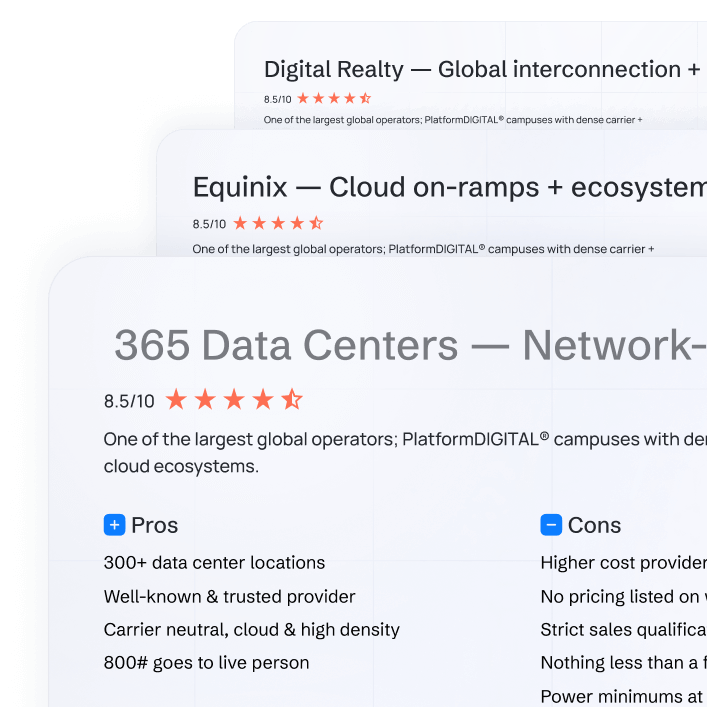
Compare Top 20 US Colocation Providers
“Hi, I’m Bob Spiegel, founder of QuoteColo.com and author of this comparison. I’ve spent 20+ years as a broker in the colocation industry, working with nearly every major US provider, hundreds worldwide, and countless regional operators. I know who delivers real value and who’s just good at marketing.
If you want pricing and a curated shortlist of providers matched to your needs (location, power, budget), message me. With access to 500+ US providers, I can save you time and money.
Enjoy the list.”

Alternative Providers to TierPoint (2026-Forward)
If you like TierPoint’s feature set but want to explore other tradeoffs (cost, geographic coverage, specialization), you might consider:
- Equinix — global colocation & interconnection leader, excellent if you need a worldwide footprint or heavy interconnection/networks.
- Digital Realty — large global REIT-style provider, good for enterprises needing multi-region presence, hybrid-cloud, and high-density deployments.
- CyrusOne — U.S.-focused colocation provider, potentially competitive on pricing/performance for regional or national workloads.
- Iron Mountain Data Centers — provides secure, compliant hosting — often preferred by clients with regulated-industry requirements (healthcare, finance, compliance).
- Smaller / regional colocation or cloud-specialist providers — for lean setups, simpler workloads, or when low latency / data-sovereignty or local compliance are priorities.
Off-List Providers From QuoteColo
We maintain a curated, private network of vetted colocation and data-center providers — many not publicly listed or not widely marketed. These facilities are typically smaller or mid-size operators, often more flexible, cost-efficient or specialized than major public providers.
What we offer through the QuoteColo network:
- Small or Mid-size operators (5–50 MW / single-site to multi-site) — ideal for small to medium deployments not needing hyperscale infrastructure.
- Energy- or efficiency-optimized data centers — located where power costs, sustainability, and connectivity are favorable.
- Regional & niche-market facilities — useful if you want lower latency, local data-residency compliance, or a location close to your users.
- Private-equity-backed or owner-operated centers — often more flexible on quotas, SLAs, and custom configurations than large REIT-style providers.
- Custom / bespoke deployment options — for users needing flexible terms, carrier-neutral connectivity, high-density / high power support, specialized compliance agreements, or non-standard physical configurations like private cage/suite or granular 1U / 2U / Half-rack / Full-rack colocation setups, as well as hybrid on-prem + colo deployments and tailored SLAs.
Compare Top 20 US Colocation Providers
We’ve brokered colocation for 20+ years across 500+ US providers.
Get an objective comparison to find real value on power, uptime, and connectivity.
View the Comparison
When TierPoint Makes Sense — and When You Should Consider Alternatives
Choose TierPoint if you:
- Operate mainly in the U.S. or want U.S.-based hosting with national coverage.
- Need a mix of colocation, cloud (public/private/hybrid), managed services, and disaster recovery — ideally all from a single vendor.
- Require compliance, security, redundancy, and carrier-neutral connectivity.
- Value flexibility and scalability — from small deployments to high-density or hybrid workloads.
- Want to outsource infrastructure maintenance, management, support and avoid building in-house data centers.
Consider alternatives if you:
- Need global (multi-continent) presence — not just U.S. coverage.
- Run small/simple workloads and prefer minimal-cost hosting or barebones colocation.
- Require deeply customized, niche configurations, or very small local presence.
- Want to avoid vendor lock-in, or maintain maximal configuration/management control.
- Have strict data-sovereignty or regulation compliance needs outside U.S. jurisdiction.
Bottom Line — Is TierPoint Right For You?
TierPoint remains a solid, mid-tier to upper-mid provider in the U.S. data-center / hybrid-IT market. For companies wishing to outsource infrastructure, leverage hybrid-cloud & managed services, and maintain flexibility across many U.S. locations — TierPoint can deliver strong value.
For small-scale, non-critical workloads, or for global/multinational operations — you may find better cost-to-value ratios or geographic coverage with other providers.
If you like, I can also build a comparison matrix: TierPoint vs 4–6 alternatives (with columns such as cost-tier, global footprint, services, compliance readiness) — to help you quickly pick based on your workload.

