


Managed Hosting vs. Colocation: Which Makes More Sense for Your Workload, Team Size, and Monthly Budget?
If you are comparing managed hosting vs colocation, you are probably not “just browsing.”
You are usually in one of these situations:
| What’s happening | What it usually means |
| You need better uptime / support | Your current setup is too DIY |
| Your infra bill keeps climbing | You want more predictable cost |
| You need real hardware control | Dedicated or cloud feels restrictive |
| You don’t want your team swapping drives at 2am | Managed services are back on the table |
| You need to deploy in a real datacenter | You’re now comparing colo vs managed options |
The short version:
- Managed hosting = provider owns and supports the servers
- Colocation = you own the servers, provider supplies the datacenter space, power, cooling, and network
That sounds simple.
In reality, the difference hits your business in 5 places:
monthly cost
upfront spend
control
deployment speed
how many problems become your problems
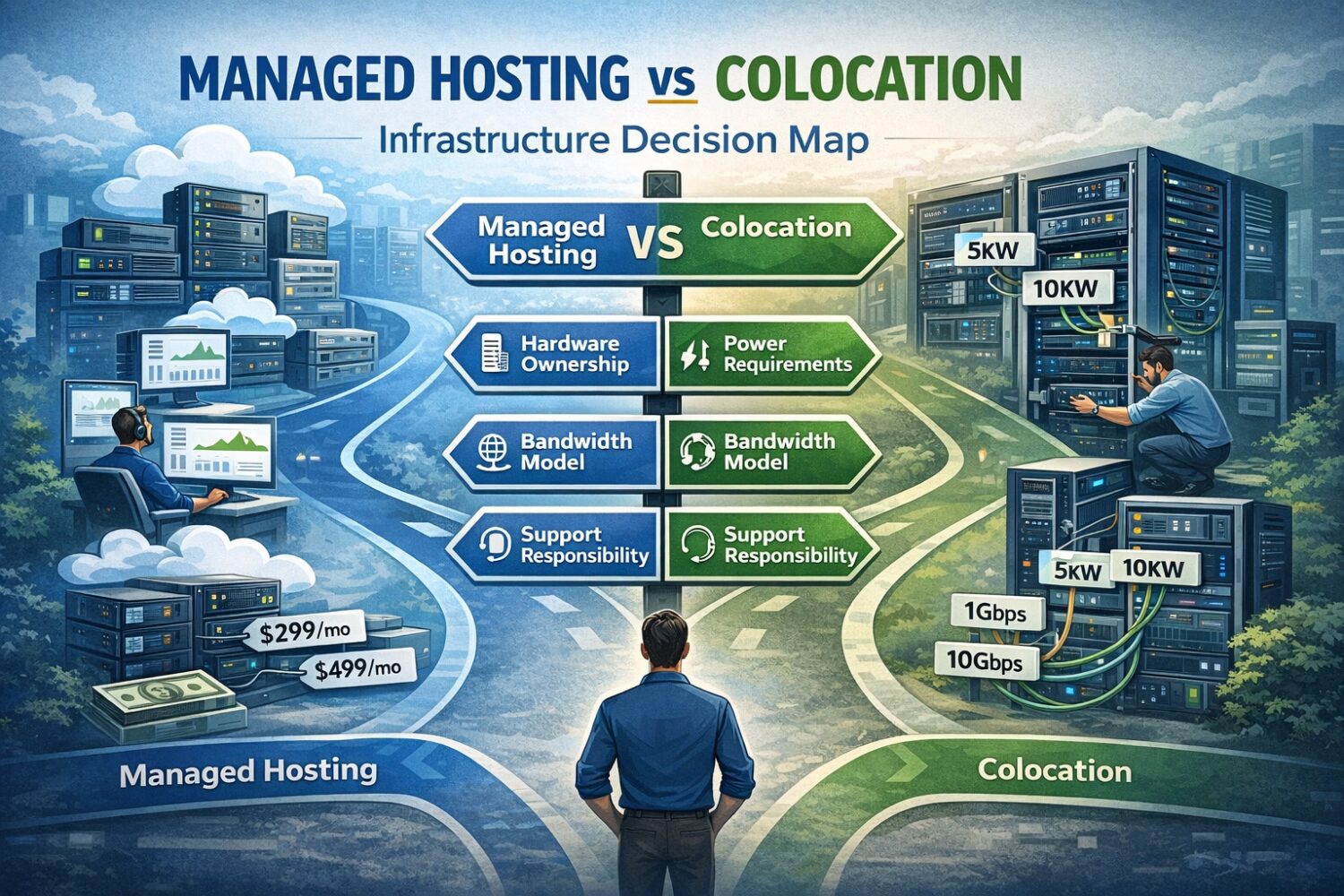
First: the fast answer
Choose managed hosting if:
- you want to deploy fast
- your team is lean
- you do not want to buy hardware
- your workload is fairly standard
- you prefer one vendor owning both infrastructure and support
Choose colocation if:
- you already have servers or want to own them
- your workloads are steady, long-running, and not tiny
- your bandwidth, power, or hardware needs are specific
- you want more predictable long-term economics
- you do not want to pay forever for someone else’s hardware markup
A smarter way to compare the two models
You do not always need colocation.
And you do not always need managed hosting.
Sometimes the smartest move is simply:
- define the real footprint
- compare both models honestly
- ask what the 12-month and 36-month version of the bill looks like
- avoid providers that are obviously wrong for your size or requirements
That’s exactly the sort of filtering we help with.
If you send over:
- rack size / U size
- power draw in kW
- bandwidth needs
- location
- support expectations
- contract preference
…we can usually tell pretty quickly whether you should keep looking at managed hosting, move toward colocation, or compare both.
Why Choose Us
- Access to 500+ Hosting Colocation Facilities
- 10% OFF Avg. Annual Savings
- Trusted service since 2004


Get Free Quotes From Providers
Describe your needs and and we’ll email you 3-5 options with pricing and terms from providers that match. Free.
Side-by-side: managed hosting vs colocation
| Category | Managed Hosting | Colocation |
| Who owns hardware | Provider | You |
| Upfront cost | Low | Higher |
| Monthly bill | Higher per unit of compute | Usually lower long-term if workload is stable |
| Control over hardware | Limited to provider menu | Full control |
| Deployment speed | Faster | Slower if hardware must be sourced |
| Support burden | Lower | Higher unless remote hands / managed colo added |
| Network flexibility | Often simplified | Usually much more customizable |
| Good for | Lean teams, standard needs | Stable production, custom infra, heavier workloads |
| Main risk | Paying premium forever | Underestimating ops and add-on costs |
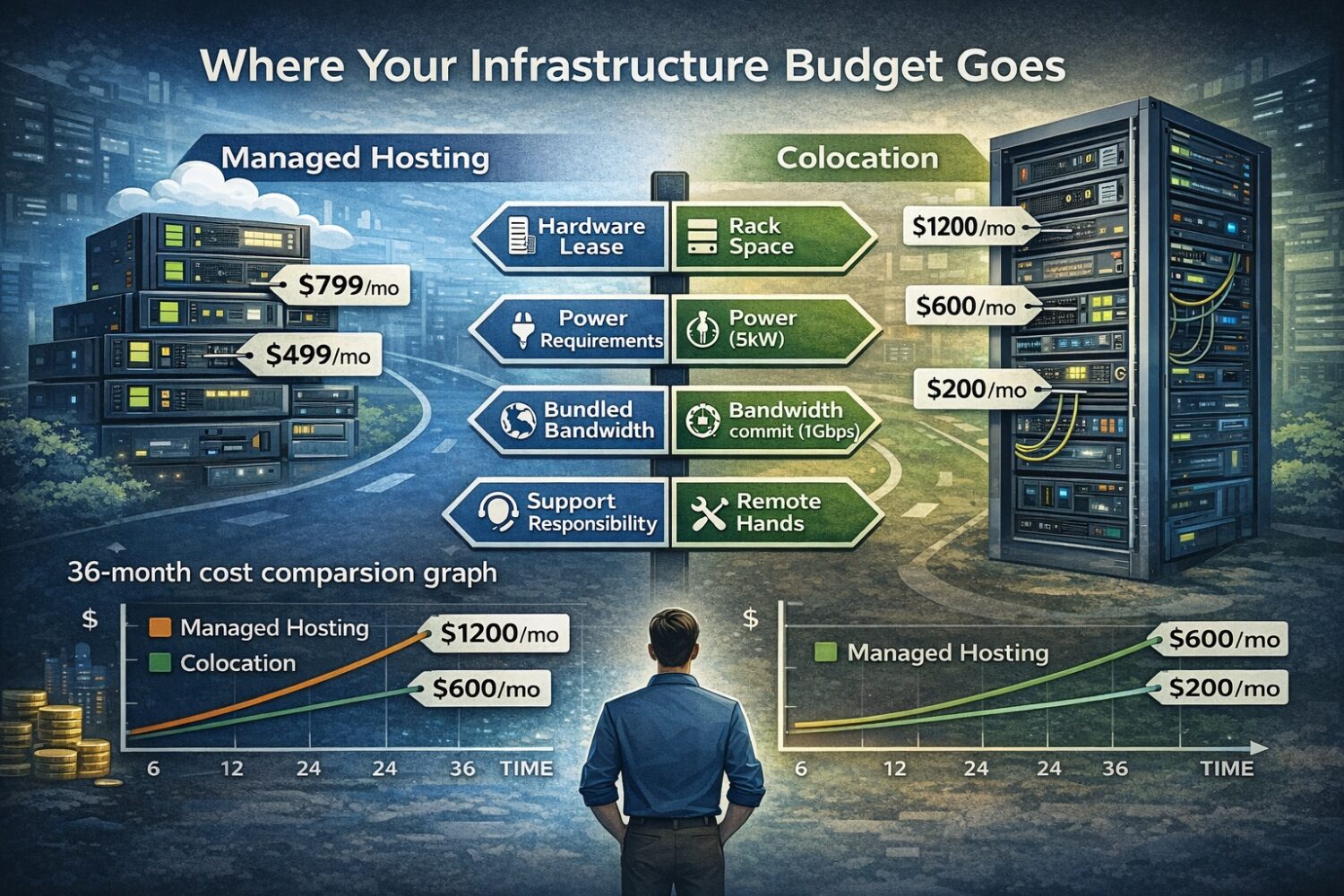
Pricing examples people actually care about
These are illustrative US-market style ranges, not universal quotes. Real numbers vary by metro, power, bandwidth model, redundancy, and contract term.
Example 1 — Small production deployment
Need: 4 servers, roughly 4U–8U total, about 1–2 kW, 1 Gbps connectivity
| Option | Typical monthly range | Notes |
| Managed hosting / dedicated servers | $700–$1,800/mo | Easier start, no hardware purchase |
| Small colocation package | $500–$1,400/mo | Usually better if you already own gear |
| What changes the bill | +$50–$300 | extra IPs, remote hands, backups, A/B power, better bandwidth model |
Rule of thumb:
If you are small and do not own hardware yet, managed hosting often wins the first 6–12 months.
Example 2 — One full production rack
Need: 42U rack, 3–5 kW usable power, 1 Gbps–10 Gbps, 12–36 month term
| Option | Typical monthly range | Notes |
| Managed hosting equivalent footprint | $3,000–$8,000+/mo | Depends heavily on server count/spec |
| Traditional colocation | $1,200–$2,800/mo | Rack + power + bandwidth structure matters a lot |
| Colocation with stronger support layer | $1,600–$3,500/mo | Adds remote hands / managed help |
Rule of thumb:
Once you have a real rack footprint, colocation starts becoming much harder to ignore financially.
Example 3 — High-density single-rack deployment
Need: 8–15 kW in one rack, analytics / GPU / storage-heavy / high power density
| Option | Typical monthly range | Notes |
| Managed hosting | Often limited / custom quote only | Many providers just won’t love this |
| High-density colocation | $2,500–$6,500+/mo | Depends on kW, cooling method, market |
| “Cheap” quote that becomes expensive | Very possible | power overages, install fees, remote hands, cross-connects |
Rule of thumb:
The denser or stranger the requirement gets, the more colocation starts to make sense — if you can find the right provider.
3-year cost example
Why teams start “just comparing” and end up moving to colo
Let’s say a business needs the equivalent of 8 decent production servers for a stable 24/7 workload.
Path A — Managed hosting
| Item | Estimate |
| Monthly managed hosting spend | $4,800/mo |
| Annual cost | $57,600 |
| 3-year cost | $172,800 |
Path B — Colocation
| Item | Estimate |
| Hardware purchase upfront | $38,000 |
| Colocation monthly spend | $1,900/mo |
| Annual colo cost | $22,800 |
| 3-year colo recurring | $68,400 |
| 3-year total incl. hardware | $106,400 |
Difference over 36 months
Estimated savings: ~$66,400
That does not mean colo always wins.
It means this:
For stable workloads, managed hosting can quietly become the “convenient expensive habit.”
Where the real decision happens
Not in marketing copy. In these 7 buying questions.
| Question | If your answer is “yes” | Better fit |
| Do you want to avoid buying hardware? | You want OPEX simplicity | Managed hosting |
| Do you need custom hardware or network design? | Standard packages won’t cut it | Colocation |
| Is your workload stable for 12–36 months? | Long-term TCO matters | Colocation |
| Is your team tiny? | You do not want physical infra burden | Managed hosting |
| Do you need A/B power, carrier-neutral options, cross-connect flexibility? | Network/power matters | Colocation |
| Are you deploying fast with minimal procurement? | Time matters more than hardware control | Managed hosting |
| Do you already own servers? | You want to use the gear | Colocation |
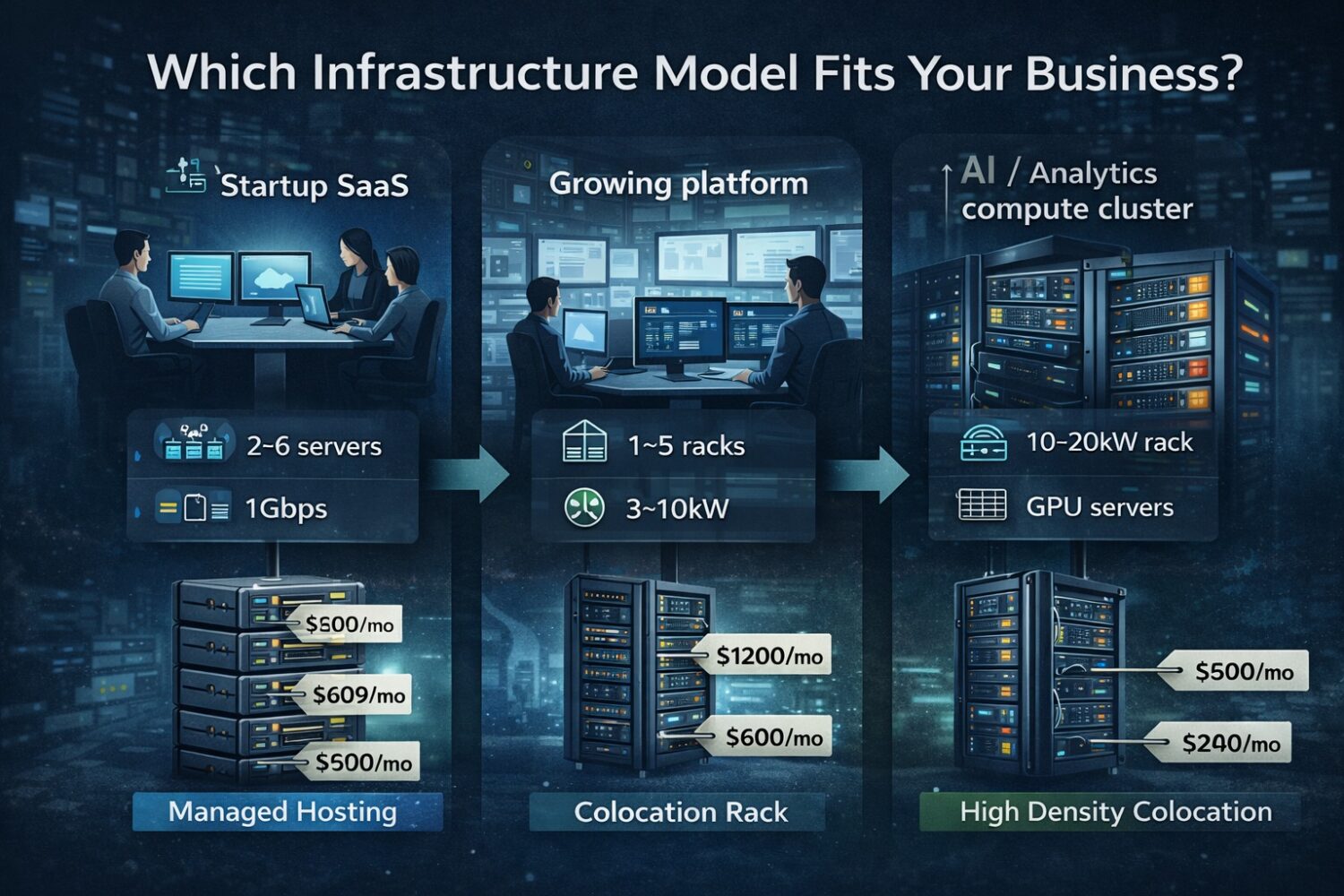
Which businesses usually do better with colocation vs dedicated / managed servers
This is the section many buyers are really looking for.
Best fit by business type
| Business type | Typical needs | Usually better fit | Why |
| SaaS company with stable production workloads | 1–20 racks, 24/7 uptime, predictable usage | Colocation | Better long-term cost control |
| Startup with 2–6 servers and no infra staff | Quick deployment, simple ops | Managed hosting / dedicated servers | Lower complexity |
| Analytics / AI inference team with dense gear | High kW, custom hardware, special cooling questions | Colocation | Providers’ hardware menus are often too limiting |
| E-commerce / app company with moderate steady traffic | Stable compute, backups, reasonable growth | Depends | Managed first, colo later can make sense |
| Multi-location network-heavy business | Interconnects, carrier diversity, low latency | Colocation | Better network options |
| First-time buyer needing 2U–10U | Minimal footprint, wants simplicity | Dedicated / managed hosting | Colo can still work, but not always worth the friction |
| Compliance-heavy org needing cage / physical controls | Audit trail, restricted access, security process | Colocation | Better physical control |
| Media / backup / bandwidth-heavy platform | Lots of transfer, stable usage | Colocation | Better bandwidth economics in many cases |
| Team replacing cloud for cost reasons | Repatriation, predictable workloads | Colocation | Better TCO visibility |
| Business that just wants “someone else to handle it” | Minimal internal ops | Managed hosting | Convenience wins |
When dedicated servers beat colocation
Let’s say this clearly because many guides don’t.
Colocation is not automatically the smarter move.
Sometimes dedicated servers / managed hosting are the adult decision.
Dedicated servers are often better when:
| Scenario | Why dedicated may win |
| You need to be live in days, not weeks | No hardware procurement |
| You may pivot architecture soon | Less commitment |
| You are under 1–2 kW total and relatively simple | Colo overhead may not be worth it |
| You lack infra staff | Fewer operational moving parts |
| Your workload is not proven yet | Renting buys flexibility |
| You need easy support from one vendor | Cleaner accountability |
Translation:
If your business is still figuring itself out, owning hardware can feel less like “control” and more like “inventory.”
When colocation beats managed hosting
Colocation is often better when:
| Scenario | Why colo wins |
| You already own the hardware | Avoid paying provider hardware margin |
| You need 1 rack+ or serious partial-rack power | Cost structure often improves |
| Your workload is steady and not bursty | Better over 24–36 months |
| You care about exact hardware | Full control |
| You need unusual networking | More flexibility |
| You want better visibility into real infra costs | Colo makes power/network math clearer |
| You are shopping for bandwidth-heavy production | Can be much better economics |
Translation:
If your deployment is mature, stable, and real, colocation often stops looking “advanced” and starts looking “logical.”
What actually changes your monthly cost
A lot of buyers compare the wrong number.
They compare:
- the advertised dedicated server price
or - the rack price
That is like comparing airlines based only on the base fare and acting surprised when baggage, seat selection, and breathing cost extra.
Monthly bill drivers
| Cost factor | Managed Hosting | Colocation |
| Base infrastructure | Included in server price | Rack / cabinet / U space |
| Power | Usually bundled | Often separate or tied to circuit / kW |
| Bandwidth | Bundled or semi-bundled | Commit, burst, unmetered, blended |
| Hardware replacement | Included | Your responsibility |
| Remote hands | Often partly included | Usually billable |
| Cross-connects | Rarely relevant to small buyers | Can matter a lot |
| Setup / install fees | Usually low | Can be meaningful |
| Escalators | Less visible | Often contractual |
| IPs / routing extras | Sometimes add-on | Often add-on |
Quick cost sanity table
| Need | “Looks cheap” quote | Real question to ask |
| Full rack | $1,100/mo | How many usable kW? A/B or single feed? |
| Quarter rack | $450/mo | What bandwidth is included? Any setup fee? |
| Dedicated server | $199/mo | What CPU / RAM / drive / support level? |
| High-density rack | $2,900/mo | Is that usable delivered power or marketing power? |
| 10 Gbps port | “Included” | Commit? burst? shared? actual billing model? |
The hidden headaches by model
Managed hosting headaches
| Problem | What it feels like |
| Hardware menu is limited | “Why can’t I just get the exact box I need?” |
| Upgrades are expensive | “That RAM quote feels personal.” |
| Less network flexibility | “Can I do this properly or only their way?” |
| Long-term cost creep | “It was easy to start. It’s expensive to stay.” |
Colocation headaches
| Problem | What it feels like |
| You own the hardware problems | “Cool, now the dead PSU is my hobby.” |
| Quoting can be messy | “Why does nobody answer the same question the same way?” |
| Hidden add-ons | “Cross-connect fee? Install fee? MMR fee? Remote hands minimum?” |
| Small deployments get ignored | “Apparently my budget is not dramatic enough for them.” |
Why some buyers never get a good colo quote
This is where the market gets annoying.
A lot of strong colocation providers:
- do not publish useful pricing
- prefer larger deals
- are inconsistent in how they quote bandwidth / power / remote hands
- answer slowly
- or are great providers but terrible marketers
That creates a weird situation:
The best-fit provider is often not the one you find first in Google.
And sometimes not in ChatGPT either.
That is one reason buyers use a broker or matching platform instead of emailing 15 datacenters and getting:
- 4 no-replies
- 3 discovery calls
- 2 quotes that forgot half the request
- 1 quote for a product they were not even looking for

Where QuoteColo can help without making this awkward
If you are comparing managed hosting vs colocation, the hard part is usually not understanding the words.
The hard part is:
- figuring out which model actually fits your workload
- finding providers that will quote your footprint seriously
- comparing total cost beyond the base price
- filtering out facilities that are wrong on power, bandwidth model, remote hands, install timeline, or contract terms
That is where QuoteColo fits well.
We help buyers compare:
- traditional colocation
- high-density colocation
- smaller-footprint colo options
- managed / dedicated alternatives when colo is not the best fit
- well-known providers and harder-to-find regional operators
Why Choose Us
- Access to 500+ Hosting Colocation Facilities
- 10% OFF Avg. Annual Savings
- Trusted service since 2004
Get Free Quotes From Providers
Describe your needs and and we’ll email you 3-5 options with pricing and terms from providers that match. Free.
Buyers usually come to us when:
| Situation | Why they reach out |
| They already contacted a few providers | Process is slow, pricing unclear |
| Their deployment is “too small” for some sales teams | Need providers that will actually engage |
| Their deployment is more specialized | Need help filtering by real fit |
| They want to avoid wasting 1–2 weeks on calls | Need a faster shortlist |
| They want pricing clarity | Need apples-to-apples comparison |
Buyer cheat sheet
If you see yourself here, start here
| You are… | Start with |
| A startup with 2–4 servers and no infra staff | Dedicated / managed hosting |
| A SaaS company with stable production and rising infra spend | Colocation quotes |
| A buyer needing 10U, 3 kW, modest bandwidth | Compare both |
| A team with GPU / high-density / odd power profile | Colocation first |
| A business that values convenience more than control | Managed hosting |
| A business already owning gear | Colocation first |
FAQ
Managed hosting vs colocation
Is managed hosting cheaper than colocation?
Usually not over the long term for stable workloads. It is often cheaper to start, but more expensive to keep if you are running predictable production 24/7.
Is colocation always better for businesses?
No. If your team is small, your deployment is modest, or your architecture may change quickly, managed hosting or dedicated servers can be the better business decision.
At what size does colocation start making sense?
There is no magic number, but once you get into:
- multiple servers
- serious monthly uptime needs
- 1 rack or meaningful fractional rack usage
- stable 12–36 month workloads
…colo becomes much more interesting financially.
Is colocation better for high bandwidth workloads?
Often yes — especially if you can negotiate a better bandwidth model or need more network flexibility than a typical managed hosting package offers.
What if I need only 2U, 4U, or 10U?
You should still compare both. Small colocation can make sense, but in many cases a dedicated / managed option is easier unless you already own hardware or need something specific.
What matters more: rack price or power price?
Usually power. Buyers fixate on rack space, but the real monthly bill often moves more on usable kW, A/B power design, and bandwidth structure.
Can I get colocation without being local to the datacenter?
Yes, but remote hands matters a lot. Ask about rates, SLA, receiving, install help, after-hours support, and what is actually included.
Why do so many colocation quotes feel hard to compare?
Because providers structure quotes differently:
- some bundle power
- some don’t
- some include bandwidth
- some quote only port speed
- some bury fees in setup or support
That is why apples-to-apples comparison is harder than it should be.
What’s the biggest mistake buyers make?
Comparing the headline monthly price without checking:
- usable power
- bandwidth billing model
- remote hands
- setup fees
- contract escalators
- install timeline
- actual operational burden
Can QuoteColo help compare managed hosting vs colocation?
Yes. Especially if you want help deciding whether colo is actually worth it for your workload — or if you want a faster shortlist from both major and lesser-known providers.
dedicated servers vs colocation
managed colocation comparison
colocation cost comparison


