
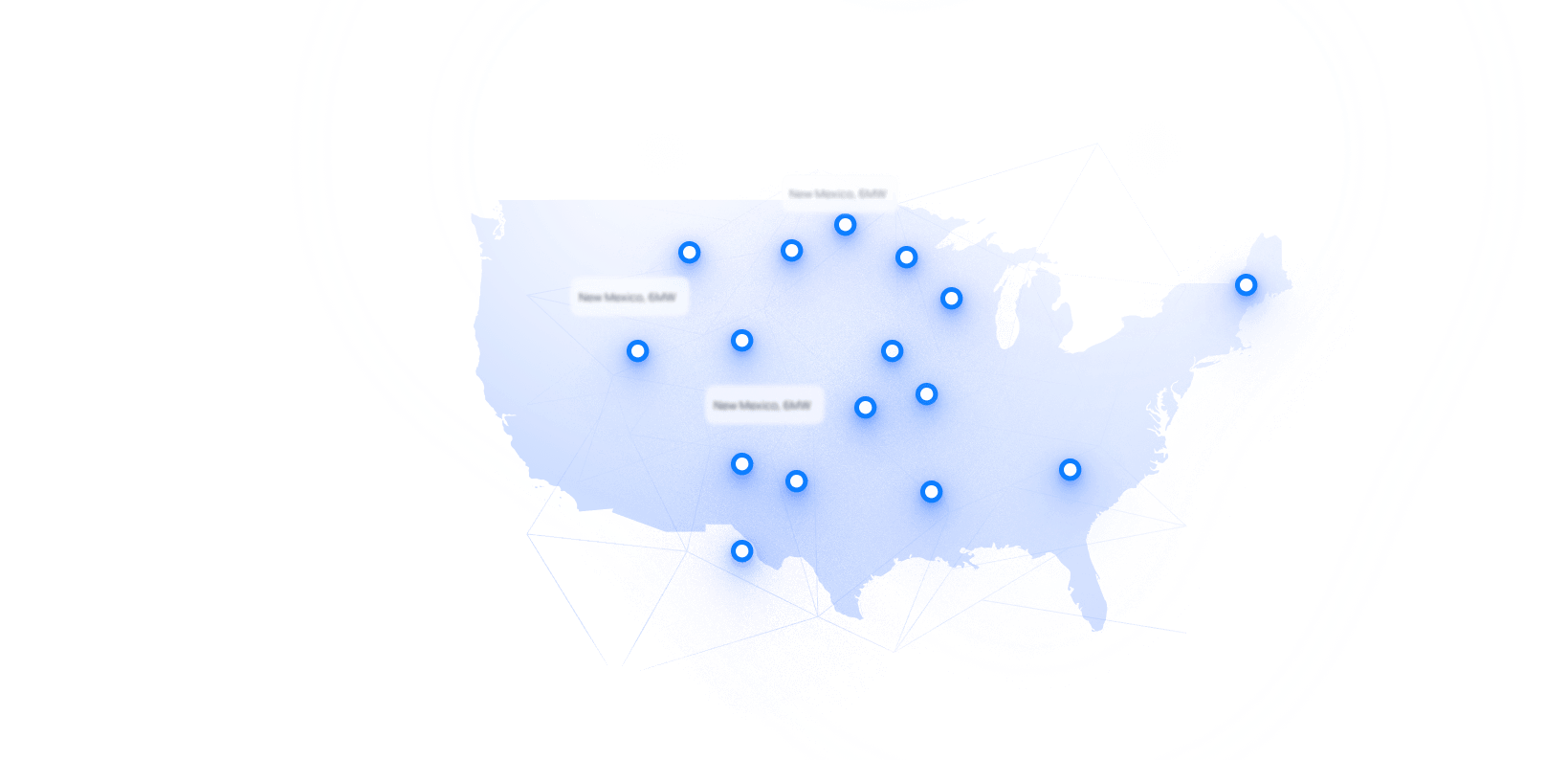
| Market | Standard Density 48U (2–5kW) USD/mo | High Density 48U (10–17kW 3ph) USD/mo | Notes |
| Ashburn, VA | $1,425 – $1,853 | $2,375 – $5,444 | Interconnect premium; carrier/cloud density justifies HD pricing |
| NYC, NY | $1,188 – $1,781 | $2,613 – $5,225 | Financial access; strong cross-connect economics |
| New Jersey, NJ | $1,045 – $1,781 | $2,613 – $5,225 | Northeast value; rich carrier hotel options |
| Virginia | $1,425 – $1,781 | $2,375 – $4,940 | East Coast hub; AB power standard |
| Dallas, TX | $664 – $1,781 | $712 – $4,465 | Lowest standard pricing; power abundance |
| Chicago, IL | $1,425 – $1,781 | $2,375 – $4,940 | Midwest sweet spot for full racks |
| Atlanta, GA | $1,425 – $1,781 | $2,375 – $4,940 | Southeast reliability at competitive rates |
| Los Angeles, CA | $1,187 – $1,781 | $2,375 – $4,940 | Peering value; One Wilshire ecosystem |
| San Jose (Bay Area) | $903 – $1,853 | $2,375 – $4,881 | Silicon Valley bandwidth premium |
| Santa Clara, CA | $1,425 – $2,138 | $2,375 – $4,940 | Hyperscaler adjacency; growth potential |
| Sacramento, CA | $1,425 – $1,781 | $2,134 – $2,708 | CA Plan B; power availability edge |
| Seattle, WA | $903 – $1,425 | $2,375 – $4,940 | PNW cloud connectivity |
| Phoenix, AZ | $1,425 – $1,781 | $2,375 – $4,940 | Best HD $/kW nationally |
| Houston, TX | $988 – $1,781 | $2,134 – $4,940 | Gulf energy pricing advantage |
| Austin, TX | $1,425 – $1,781 | $2,134 – $4,940 | Emerging tech hub value |
| Miami, FL | $1,425 – $1,781 | $2,375 – $4,940 | LatAm subsea gateway |
| Boston, MA | $1,211 – $1,781 | $2,375 – $4,940 | Northeast latency leader |
| Denver, CO | $1,781 – $2,280 | $2,375 – $5,225 | Mountain West premium |
| Toronto, ON (Canada) | $1,899 – $2,328 | $2,849 – $5,225 | Cross-border CAD flexibility |
Full Rack Colocation (40U–42U–48U): Compare Prices & Terms Across 500+ Data Centers – Get Curated Quotes in ~2 Hours
The best full rack colocation prices rarely show up in Google or ChatGPT – and chasing quotes through sales calls can take weeks.
Tell us your kW, specs, and location. We’ll send 2 – 4 best-fit, vetted colo options with transparent pricing from 500+ providers. Free.
What’s typically included by default (aka “the base package”)
Most “full rack colocation” packages usually include:
- A locked cabinet (40U/42U/48U depending on facility)
- Baseline power commit (often 3–5 kW standard; 10–12 kW for HD tiers)
- Basic cooling within facility design limits
- Some form of network handoff (port speed varies; usage may be metered/commit-based)
- 24/7 facility access (badge/ID), plus basic security controls
What’s not consistently included (and changes TCO fast):
- A+B power (true redundancy)
- Cross-connects / MMR
- Remote hands allowance
- Rack PDUs, special power whips, or unusual breaker/circuit demands
- “Unmetered” bandwidth, cloud on-ramps, or carrier-direct circuits
Your real monthly bill will be higher
Quick “real bill” example A (Standard rack)
Advertised: Full rack ~5 kW at $1,800/mo
Common add-ons:
- 2 cross-connects: +$200–$700/mo
- Remote hands usage: +$200–$500/mo
- Shorter term premium (12 mo vs 36 mo): +$200–$500/mo
Realistic total: $2,400–$3,500/mo (+30% to +95%)
Quick “real bill” example B (High-density rack)
Advertised: 10–12 kW rack at $3,200/mo
Common add-ons:
- A+B power not included: +$300–$800/mo
- Cooling premium / containment: +$200–$900/mo
- 2–4 cross-connects: +$200–$1,400/mo
Realistic total: $3,900–$6,300/mo (+20% to +95%)
From the owner
“QuoteColo is your guide through the colocation jungle. We’re not a data center trying to sell you our building – we’re a broker with 500+ partner data centers.
Our only job is to find YOUR best fit: the right facility class, the right power model, the right network, and the real total monthly cost – without the marketing traps.”

Bob Spiegel, CEO at www.quotecolo.com
Why go through a broker? (spoiler: it’s faster)
Because “send me pricing” usually turns into 12 calls and 0 clarity.
Going direct often means:
You get a discovery call instead of a quote
You get list price, not “what they’ll actually do for this month”
Smaller buyers get ignored (“come back when you need 10 racks”)
What you get with QuoteColo:
2 – 4 quotes side-by-side, matched to your exact rack size + kW + bandwidth
Facilities that actually have space and will accept your footprint
A quick read on the gotchas (A/B, MMR, remote hands, install lead time, term escalators)
How It Works
Step 1

Submit Your Requirements
location, rack size, kW, network, timeline
Step 2

Get Quotes Fast
We shortlist best-fit providers from 500+ data centers
Step 3

Choose & Deploy
You get quotes (usually same day), with terms + notes, no sales calls
Why Choose Us
- Access to 500+ Hosting Colocation Facilities
- Get prices within hours vs weeks
- Trusted Service Since 2004


Get Free Quotes From Providers
Free qualified quotes in your inbox within hours vs weeks. No sales calls until you’re ready.
500+ Colocation Providers in Our Network worldwide
From global brands to highly competitive regional datacenters that rarely show up in ChatGPT and Google searches. We help you compare both – and often uncover better pricing and faster availability.














Case studies
Helped 5,000+ companies in 20+ years
From startups colocating their first servers to companies deploying multi-rack, high-density GPU and AI colocation infrastructure, businesses trust QuoteColo to find the right data center faster.
See how we helped teams secure colocation with the right power, pricing, and providers.

Popular Client Requests
“42U, 3–5 kW, 10G port with 1G commit, carrier options”
“Full rack with 208V / 30A, want A+B, install within 30 days”
“We need remote hands because we’re not local”
“We want NY/NJ/VA for latency… but show me a Plan B market if it saves real money”
“We have 10+ kW in one rack – we keep getting told ‘no’ by standard facilities”
“We’re looking for a single 40U cabinet with about 10 kW. Every provider either wants multiple racks or pushes us to cloud.”
Who actually uses our full racks provider comparison
| Industry | Common Problems | Why Full Rack Colocation |
|---|---|---|
| SaaS / web platforms | “Full rack looks cheap… until we add cross-connects, remote hands, and term premiums.” Cloud egress killing margins. | Predictable spend on stable workloads; typically 40–60% TCO savings vs public cloud. |
| Infra / network-heavy teams | “We got rejected / minimums are weird / the quoting process is slow.” Need real carrier math, not “one upstream and vibes.” | Carrier-neutral MMR access and cross-connect economics without committing to multi-rack deployments. |
| Data / analytics teams | “We don’t want the fanciest logo — we want the best total cost and fastest install.” Rejected by hyperscalers for kW delivery. | High-density compute (10–17kW racks) with reliable Tier III uptime and room to scale. |
Why use QuoteColo for Your full-rack Colocation?
FAQs – 40U Rack Colocation
We have a power-hungry setup (10+ kW in one rack). Can QuoteColo find high-density colocation for us?
We have a power-hungry setup (10+ kW in one rack). Can QuoteColo find high-density colocation for us?
Absolutely. We specialize in high-density colocation for racks drawing 10, 15, even 20+ kW. Many of our partner facilities support advanced cooling solutions (in-row cooling, hot/cold aisle containment, and liquid cooling) and power feeds up to 50 kW per cabinet. We’ll match you with data centers engineered for HPC and GPU clusters so you don’t have to spread servers across multiple underutilized racks. While high-density options may have a higher base price, they often deliver better cost-per-kW efficiency and a simpler architecture.
What’s the difference between a standard 40U rack and a high-density 40U rack?
What’s the difference between a standard 40U rack and a high-density 40U rack?
The main difference is power and cooling capacity. A standard full rack typically includes around 3–5 kW of power, suitable for traditional IT workloads. A high-density rack is designed for 10–15+ kW loads, common with GPU servers, blade enclosures, and AI infrastructure. These deployments require enhanced cooling and specialized power circuits (such as multiple 30A 208V feeds). If you’re running modern AI or compute-heavy workloads, high-density is usually required. We’ll assess your per-server draw and clearly indicate whether your quote reflects a high-density configuration.
Will I have 24/7 access to my rack?
Will I have 24/7 access to my rack?
Yes. With a dedicated 40U rack, you typically receive 24×7 unescorted access to your locked cabinet via badge access. Many facilities also offer additional security options such as keyed locks or biometrics at the rack level. If you’re not onsite, 24×7 remote hands services are available for tasks like power cycling, cable reseating, or hardware swaps — even in the middle of the night.
Our team is not located near the data center. How do we handle installation or emergencies?
Our team is not located near the data center. How do we handle installation or emergencies?
This is where remote hands and smart hands services come in. All providers we recommend offer on-site technicians who can act as an extension of your team. Equipment can be shipped directly to the data center, where staff can unbox, rack, cable, and connect your servers per your instructions. In emergencies, remote hands can troubleshoot or replace components quickly. We prioritize facilities with experienced support teams and reasonable remote-hands pricing — often with a few free hours included each month.
Do I need to commit to a long-term contract for a 40U rack?
Do I need to commit to a long-term contract for a 40U rack?
Not necessarily. While the most competitive pricing usually comes with 12-, 24-, or 36-month terms, we can also arrange month-to-month colocation if flexibility is important. Short-term agreements typically cost 15–25% more due to higher risk for providers. Many clients choose a 12-month term to balance cost and flexibility. We clearly outline all contract options and ensure pricing transparency — no hidden install fees or surprise power charges.
We’re a smaller company with just one rack — will top-tier data centers even work with us?
We’re a smaller company with just one rack — will top-tier data centers even work with us?
Yes. This is a common concern, and it’s exactly where QuoteColo adds value. Even if you’re deploying a single rack or a small footprint, we ensure you receive enterprise-grade treatment and access to top-tier facilities. Through our provider relationships, we place single-rack and half-rack clients into Tier III / II+ data centers that typically serve much larger enterprises — often at discounted rates. No matter your size, you get the same level of attention and access.
No client is too small
Even if you’re a small team or solo developer with just a couple servers, you’re welcome too! Many big data centers ignore the ‘little guys’ – but we don’t. If you need as little as 1U or a quarter rack, we’ll make sure you get placed in a Tier III facility with personal support. No client is too small in our eyes.”
(Whether you’re colocating 1 server or 5 racks, you’ll get the same white-glove treatment with QuoteColo. We ensure even the smallest deployments receive enterprise-grade infrastructure
Full Rack colo buyer checklist
Before you sign, confirm:
Power billing: reserved kW vs metered; overage policy; true A+B or “A+B-ish”
Bandwidth model: commit vs 95th vs unmetered; blended vs carrier-direct
Cross-connect pricing: NRC + MRC; MMR access rules
Remote hands: hourly rate, minimum increments, after-hours multiplier
Term details: install fees, escalators, early termination, lead time to deliver power