


When companies start looking for colocation hosting, they quickly encounter two terms that can be confusing:
Retail colocation and wholesale colocation.
Both involve placing your servers in a third-party data center. Both provide power, cooling, connectivity, and physical security. But the scale, pricing model, and deployment process are very different.
For infrastructure teams, choosing the wrong model can create unnecessary cost, longer deployment timelines, or capacity constraints later.
This guide explains how the two models differ, what typical deployments look like, and how companies decide which type of colocation is right for their infrastructure.
The Quick Explanation
The easiest way to understand the difference is to look at deployment size and purchasing model.
| Feature | Retail Colocation | Wholesale Colocation |
| Typical rack count | 1–20 racks | 20–200+ racks |
| Power commitment | 1–50 kW | 100 kW – several MW |
| Space model | Shared floor or cages | Dedicated suites |
| Contract terms | 12–36 months common | 3–10 years common |
| Setup speed | Weeks | Months (sometimes longer) |
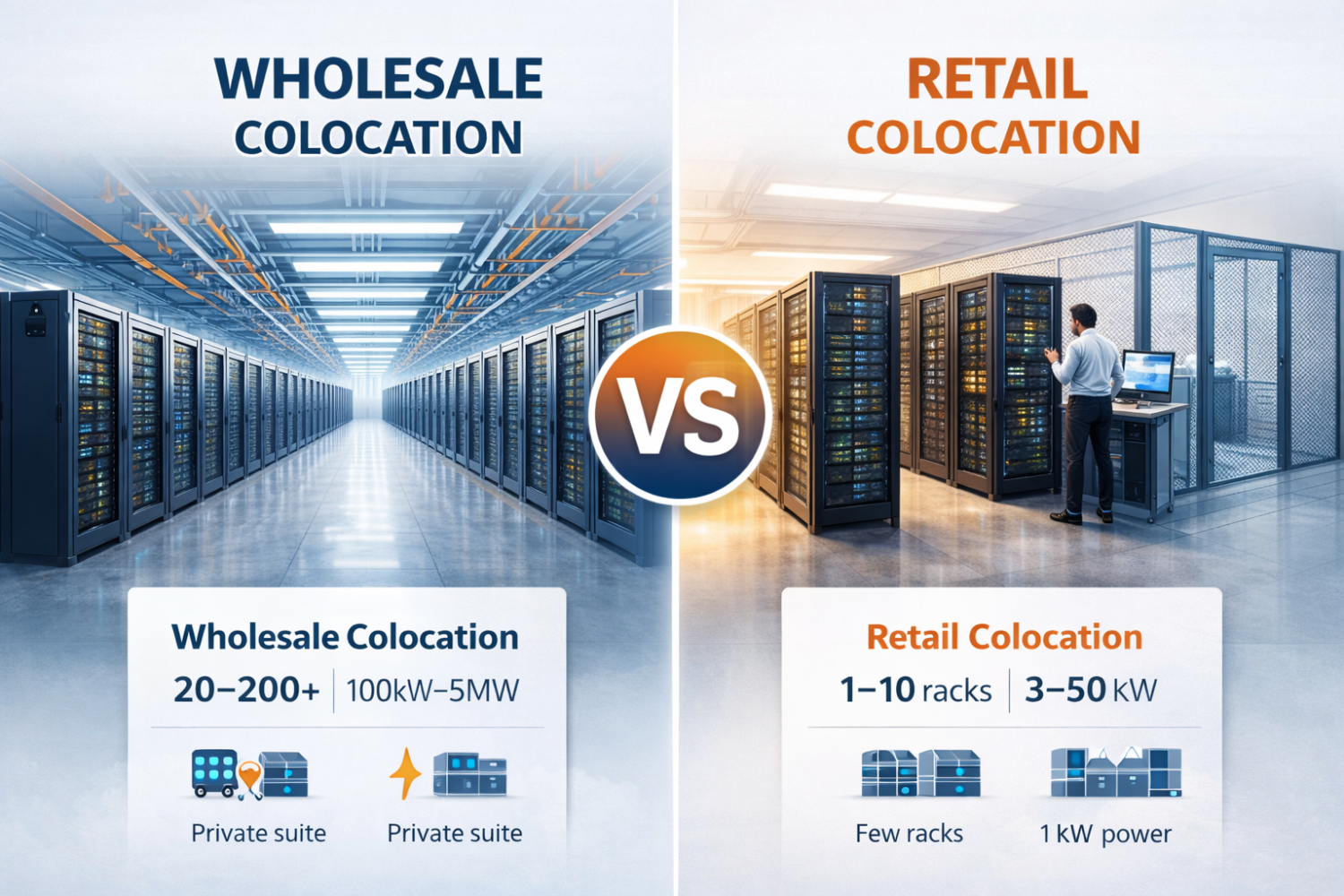
Retail colocation is essentially rack-by-rack infrastructure leasing.
Wholesale colocation, by contrast, resembles leasing a private data center inside a larger facility.
Both play an important role in modern infrastructure strategies.
Retail Colocation: How It Works
Retail colocation is the most common form of colocation hosting.
Companies rent a specific amount of rack space inside a shared data center environment. This may be:
- a few rack units (1U–10U)
- a partial rack
- a full cabinet
- several cabinets
The data center operator provides the physical environment including power delivery, cooling systems, network connectivity, and security – while the customer installs and manages their own servers.
Retail colo deployments often look like this:
| Deployment Type | Typical Example |
| Small footprint | 2–10U servers for backup or edge workloads |
| Standard rack | One 42U cabinet with 3–5 kW |
| Growing SaaS platform | 4–10 racks with 5–8 kW each |
Retail colocation works particularly well for organizations that want predictable infrastructure without committing to large-scale deployments.
Typical customers include:
- SaaS startups launching their first infrastructure
- companies moving workloads out of public cloud
- enterprises deploying regional infrastructure
- network providers needing presence in multiple metros
Retail colocation also allows companies to scale gradually, adding cabinets as demand grows.
Wholesale Colocation: Designed for Larger Deployments
Wholesale colocation is intended for organizations deploying large infrastructure footprints.
Instead of renting individual racks, customers lease entire data center suites or large sections of the facility. The deployment typically involves dozens or hundreds of racks and significant power capacity.
Wholesale colocation deployments often begin around 100 kW of power and can grow to several megawatts.
Typical wholesale specifications might look like this:
| Metric | Typical Range |
| Rack count | 20–200+ racks |
| Power density | 5–15 kW per rack |
| Total power capacity | 100 kW – 5 MW |
| Connectivity | 10G–100G networks |
Because these deployments require significant infrastructure planning, contracts are usually longer and installations may take more time.
Organizations that typically choose wholesale colocation include:
- large SaaS platforms
- global hosting providers
- analytics and AI platforms
- enterprises consolidating multiple data centers
Wholesale colo environments often provide dedicated power distribution, private suites, and customized network architecture.
When Companies Start With Retail and Move to Wholesale
Many companies don’t immediately deploy wholesale infrastructure. Instead, they begin with retail colocation and scale over time.
A typical growth path looks something like this:
| Stage | Infrastructure Deployment |
| Early infrastructure | 1–2 racks |
| Growing SaaS platform | 5–10 racks |
| Scaling platform | 20+ racks |
| Enterprise deployment | Dedicated wholesale suite |
This gradual progression allows companies to validate infrastructure requirements before committing to large power contracts.
Retail colocation is therefore often the starting point, while wholesale becomes attractive once infrastructure reaches significant scale.
Pricing Differences Between Retail and Wholesale
Retail and wholesale colocation use different pricing models. Retail colocation pricing is usually calculated per rack or per cabinet, with power included as part of the monthly recurring cost. Wholesale colocation pricing is typically based on power consumption (kW) and large capacity commitments.
A simplified comparison might look like this:
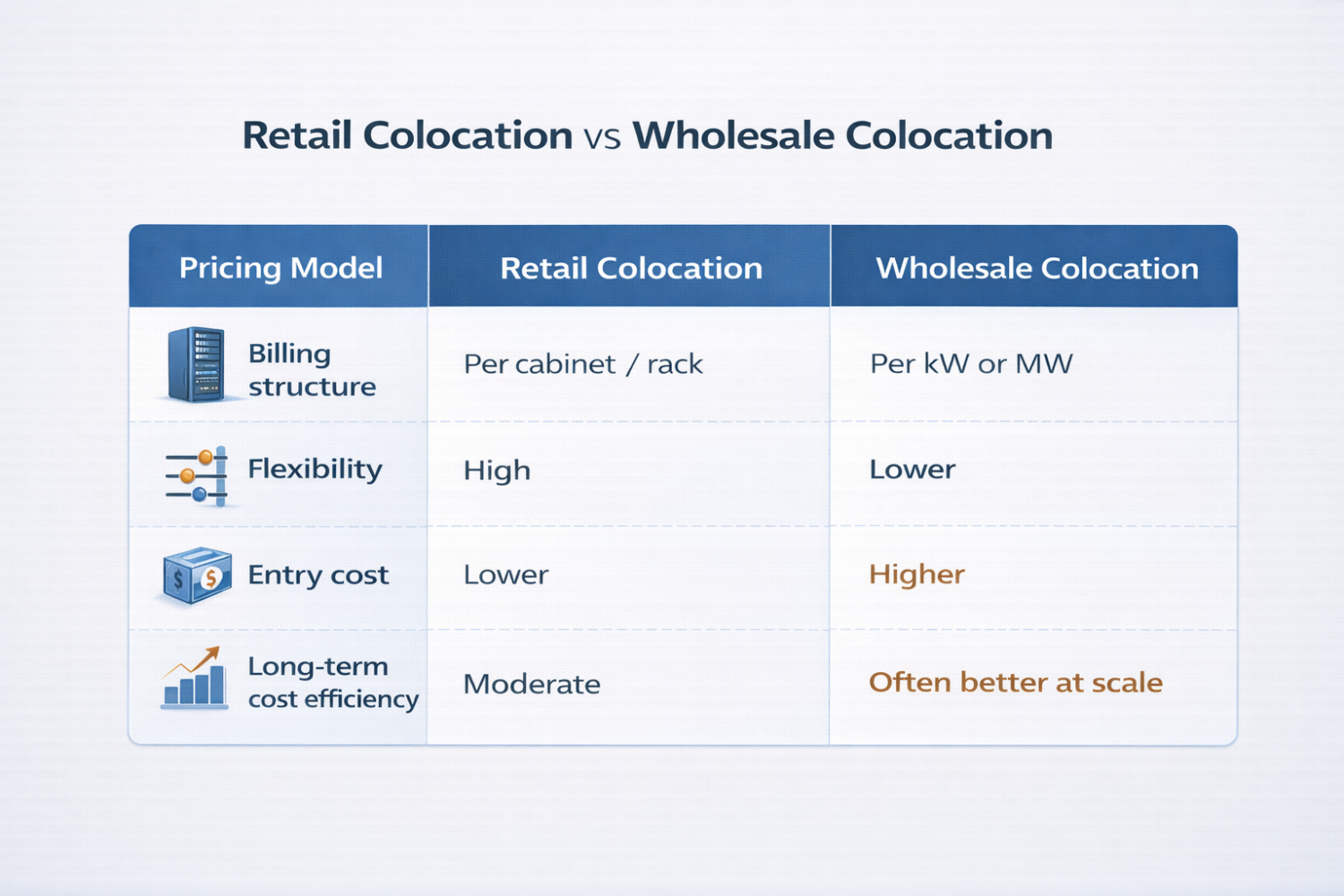
For smaller deployments, retail colocation is generally the most practical option. For larger deployments, wholesale pricing can become significantly more cost-efficient.
The Procurement Challenge: Finding the Right Provider
One challenge companies frequently encounter when looking for colocation is procurement friction.
Many providers:
- do not publish pricing publicly
- require minimum commitments
- have different power billing models
- charge varying cross-connect and remote hands fees
As a result, infrastructure teams often spend weeks contacting providers individually to understand which facilities can support their requirements.
According to QuoteColo’s experience helping companies find colocation space, comparing multiple providers often reveals significant price differences. Organizations frequently save around 10% annually when they compare qualified providers with a broker like QuoteColo instead of contacting 5-10 data center operators.
Why Choose Us
- Access to 500+ Hosting Colocation Facilities
- 10% OFF Avg. Annual Savings
- Trusted service since 2004


Get Free Quotes From Providers
Describe your needs and and we’ll email you 3-5 options with pricing and terms from providers that match. Free.
What CTOs Are Actually Optimizing For Today
For most infrastructure leaders, the decision between retail and wholesale colocation is not just about rack count.
In 2026, infrastructure teams are typically optimizing for three main factors:
1. Cost control vs public cloud
Many organizations are reevaluating cloud spending and moving predictable workloads to colocation environments.
2. Connectivity and interconnection
Carrier-neutral facilities with strong network ecosystems, such as Ashburn, Dallas, or Los Angeles, remain strategically important.
3. Deployment speed
Power availability has become a critical factor. In some markets, installation timelines depend more on available power capacity than on available floor space.
These factors often determine which colocation providers are actually viable for a given deployment.
How QuoteColo Broker Helps Companies Compare Colocation Providers
Because colocation providers rarely publish pricing or availability information, infrastructure teams often struggle to identify which facilities match their requirements.
QuoteColo works as a colocation matching platform that helps companies compare qualified providers quickly, free of charge.
Instead of contacting dozens of facilities, customers share their technical requirements and receive a shortlist of providers that match their deployment.
Typical factors evaluated include:
- power pricing and kW cost
- A/B redundant power configuration
- bandwidth models (commit or unmetered)
- cross-connect costs and carrier ecosystem
- remote hands availability and SLAs
- installation timelines and contract terms
This approach helps infrastructure teams avoid spending weeks speaking with facilities that may not actually support their deployment.
FAQ
What is retail colocation?
Retail colocation is the most common type of colocation hosting. Companies rent individual racks or cabinets inside a shared data center environment.
What is wholesale colocation?
Wholesale colocation involves leasing large sections of a data center – often starting around 100 kW of power – for large infrastructure deployments.
How many racks count as wholesale colocation?
Wholesale deployments typically start around 20–50 racks, although the exact threshold varies between providers.
Is wholesale colocation cheaper than retail?
At large scale, wholesale colocation often becomes more cost-efficient because power pricing is negotiated at higher capacity levels.
Can companies move from retail to wholesale later?
Yes. Many companies begin with retail colocation and transition to wholesale deployments as their infrastructure grows.


