Colocation Hosting Pricing – 20 Major US & Canada Markets:
*Estimated Monthly Costs from our providers (2026):

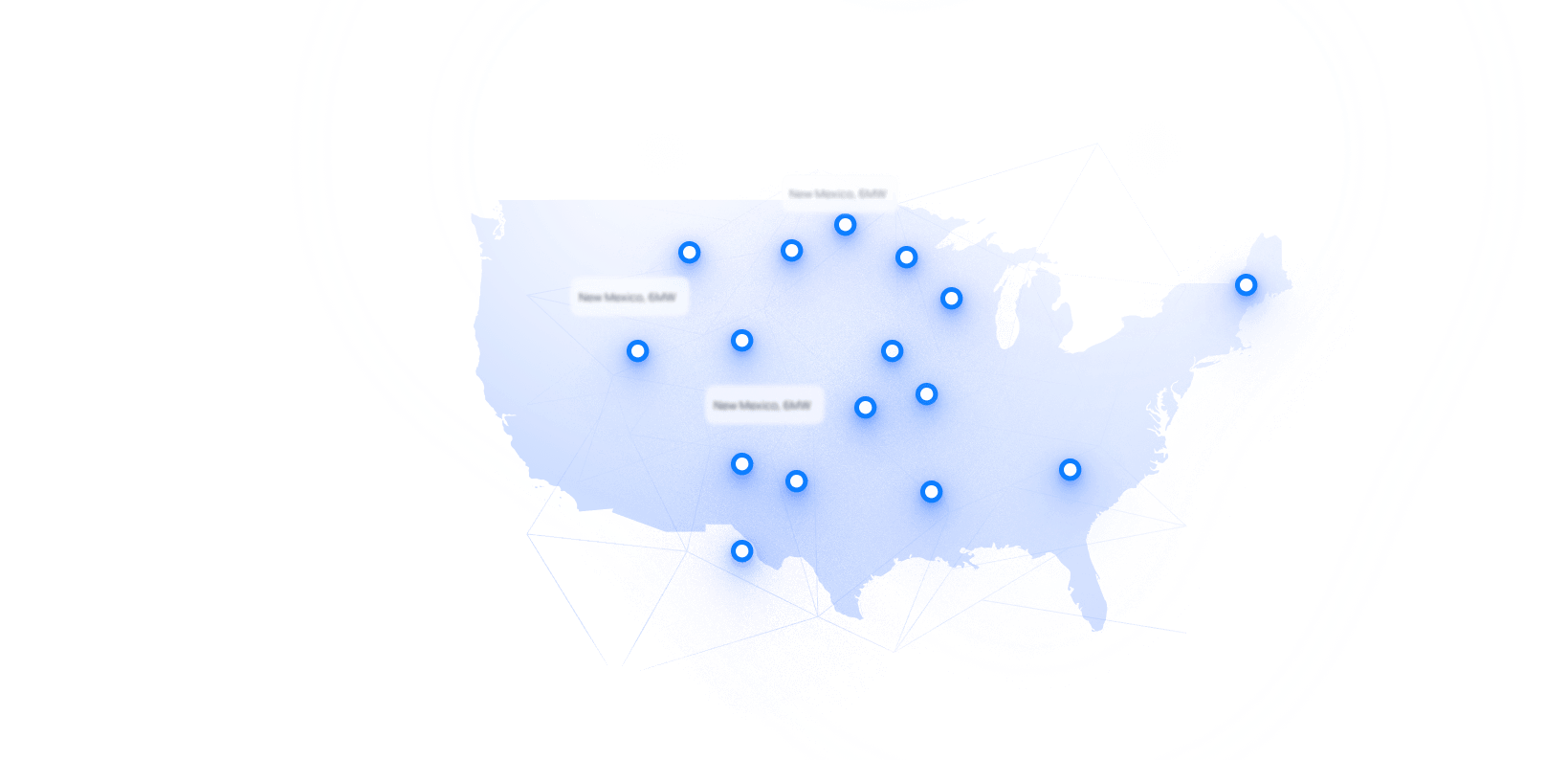
“Why QuoteColo is Unique: We’re not a data center trying to sell you on our facility – we’re a broker with 500+ partner data centers. That means our only job is to find YOUR best fit. We compare providers and hand-pick the ones that meet your needs. You get unbiased recommendations at no charge.”

| Location | 2U (≈0.5–1 kW) | Half Cabinet (≈20U – 2–4 kW) | Full Rack (42U – ≈5 kW) | High-Density Rack (42U – ≈10–12 kW) |
| Ashburn (VA) | $120 – $220 | $900 – $1,300 | $1,500 – $2,500 | $2,200 – $4,800 |
| New York Metro | $150 – $250 | $1,000 – $1,500 | $1,600 – $3,000 | $2,500 – $5,000 |
| Silicon Valley (CA) | $140 – $230 | $900 – $1,400 | $1,600 – $2,800 | $2,300 – $4,800 |
| Los Angeles (CA) | $130 – $210 | $800 – $1,200 | $1,200 – $2,500 | $2,000 – $4,500 |
| Chicago (IL) | $120 – $200 | $800 – $1,200 | $1,100 – $2,300 | $1,800 – $4,000 |
| Dallas (TX) | $100 – $190 | $700 – $1,100 | $1,000 – $2,100 | $1,700 – $3,500 |
| Atlanta (GA) | $100 – $180 | $700 – $1,000 | $1,100 – $2,200 | $1,800 – $3,800 |
| Seattle (WA) | $100 – $170 | $600 – $900 | $1,000 – $2,000 | $1,800 – $3,500 |
| Phoenix (AZ) | $110 – $180 | $750 – $1,050 | $1,300 – $1,600 | $2,100 – $4,400 |
| Miami (FL) | $110 – $190 | $800 – $1,100 | $1,100 – $2,300 | $1,900 – $4,000 |
| Boston (MA) | $120 – $190 | $800 – $1,200 | $1,200 – $1,800 | $2,400 – $4,900 |
| New Jersey (NJ) | $95 – $160 | $650 – $950 | $1,050 – $1,800 | $2,500 – $5,000 |
| Houston (TX) | $75 – $130 | $700 – $950 | $1,000 – $1,800 | $2,100 – $4,900 |
| Denver (CO) | $150 – $380 | $1,200 – $1,600 | $1,800 – $2,300 | $2,500 – $5,200 |
| Philadelphia (PA) | $260 – $520 | $1,600 – $1,850 | $1,600 – $1,950 | $2,600 – $5,400 |
| Portland (OR) | $300 – $500 | $1,200 – $1,450 | $1,500 – $1,800 | $2,500 – $5,200 |
| San Jose (CA) | $70 – $100 | $750 – $1,750 | $950 – $1,950 | $2,500 – $5,100 |
| Toronto (ON) | $150 – $300 | $1,300 – $1,500 | $2,000 – $2,450 | $3,000 – $5,500 |
| Montreal (QC) | $300 – $500 | $1,200 – $1,450 | $1,500 – $1,800 | $2,500 – $5,200 |
| Vancouver (BC) | $250 – $500 | $1,500 – $1,750 | $1,500 – $1,900 | $2,500 – $5,200 |
*Actual quotes will vary by date, exact power draw, bandwidth, and contract term. High-density pricing assumes >=10 kW per rack with advanced cooling. For a precise cost tailored to your needs, request a Custom Quote.

Share your specific needs (e.g., power, location, etc.).


Multiple qualified providers will connect with you directly. You decide on which option is best for organization. There is no obligation.

Describe your needs and and we’ll email you 3-5 options with pricing and terms from providers that match. Free.
Think of the “rack price” as the base. The real bill is base + power model + network + cross-connects + hands + contract terms.
Reserved kW vs metered kWh
If you over-reserve: +10–30% monthly (you pay for unused headroom)
If you meter and spike: +5–25% monthly in months with bursts
A+B power (true redundancy)
If not included: +10–20% monthly (or +$200–$800/mo on a 5–12kW setup)
3-phase power / larger breaker
Often a premium: +$100–$500/mo depending on facility
Power overages
Easy surprise: +$150–$1,500/mo if you exceed cap and get hit with overage pricing
Rule of thumb: power choices can move the bill +15–45%.
95th percentile vs flat-rate commit
Mis-sized commit or bursty usage: +5–25% monthly
“Blended bandwidth” vs buying from your own carrier
Blended can be cheaper for small commits, but pricier at scale:
Delta: ±5–20% monthly depending on commit size and market
Unmetered options
Usually not “cheap unmetered”: often +10–40% vs a right-sized commit
Rule of thumb: network structure can move the bill +5–35%.
This is where a lot of “cheap rack” deals stop being cheap.
One-time cross-connect install
Typical: $250–$1,000 per cross-connect (NRC)
Monthly cross-connect recurring
Typical: $75–$350/mo per cross-connect
If you need 2–4 cross-connects (common)
Add: +$150–$1,400/mo total
That’s often +5–25% on a small/mid deployment
Rule of thumb: connectivity plumbing is +5–25% (sometimes more if you’re carrier-heavy).
Hourly rate
Typical: $125–$250/hr
Minimum increments
Common: 30–60 minutes minimum
After-hours
Often: 1.25× – 2×
Realistic monthly spend
Light-touch: $0–$200/mo
Normal: $200–$800/mo
Hands-heavy ops: $800–$2,500+/mo
Rule of thumb: adds 0–20% depending on how often you “need a human”.
Containment / premium cooling
Add: +5–20% monthly
If you’re pushing the envelope (dense GPUs, hot exhaust)
Add: +$300–$2,000/mo depending on cooling method + facility constraints
Rule of thumb: HD cooling adds +5–25%.
Short term (month-to-month / 6–12 mo) vs 36 mo
Premium: +10–30% monthly
Annual escalator
Common: +3–5% per year
Over 36 months, that’s effectively ~+6–10% blended increase vs flat
Cross-connect / remote hands pricing locked vs variable
Can change your “true total” by +3–10% over time
Rule of thumb: term structure changes +10–30% up front + 3–5%/yr ongoing.
SOC2 / ISO / audit support
Usually not massive but not zero:
Add: +$100–$700/mo or +2–10% depending on package
Describe your needs and and we’ll email you 3-5 options with pricing and terms from providers that match. Free.















Price vs Value
“Enterprise IT knows the dilemma: Tier-3 colocation brands charge a 30%+ premium for their logo, yet ultra-cheap offers can mean cut corners on reliability. We cut through the hype to find you enterprise-grade facilities without the sticker shock, ensuring you’re not overpaying for ‘bells and whistles’ you don’t need”
Enterprise-Class Facilities
Most options we present meet at least Tier III standards (≈99.99% uptime), many with SOC 2/SSAE-18 certifications and 24×7 on-site support. We focus on 2N power redundancy, robust cooling, and rigorous security at all data centers we recommend. In short, you get the uptime and compliance your CFO and auditors demand, without the usual research hassle.
We’ve got you. Our partner facilities support 10-50 kW+ per rack, with options like liquid cooling and blade-ready enclosures. We specifically match you with data centers engineered for HPC: think 80 kW per cabinet potential, redundant cooling systems, and specialized power feeds. You won’t outgrow these sites anytime soon.

Whether you’re colocating 1 server or 5 racks, you’ll get the same white-glove treatment. (In fact, many of our clients are small startups or solo developers that the big data centers ignore.) No deployment is too small: if you need just 1U or a quarter cabinet, we can still place you in a Tier III facility and give you personal support. You won’t be shrugged off for not being a Fortune 500 – we’ve got your back.
Describe your needs and we will be in touch shortly with additional details and pricing information.
Colocation hosting is when a company places its own servers and hardware in a third-party data center. The business keeps ownership of the equipment, while the provider delivers space, power, cooling, connectivity, and security. This way, companies get enterprise-level infrastructure without the expense of building and running their own facility.
Yes, absolutely free with no obligation. Our providers will pay us a simple referral fee if you sign up with one of them.
After reviewing your requirements, we connect you directly with qualified colocation hosts. They will provide pricing and additional information based on your specifications. You make an informed decision.
Most customers prefer email. If a phone call is requested, we will schedule a time and date to discuss your requirements on a phone call.
Yes, we provide basic guidance and general pricing. For more intensive questions, we will connect you directly with qualified colocation providers that can better answer your exact questions.
Some colocation hosts offer per-U colo options, making them an attractive choice for those seeking affordable colocation solutions. For example, Houston, Texas offers $79/month for 1U rack space, 1 Amp 208-volt power, and 1Gbps unmetered bandwidth. In New Jersey, plans start at $109/month for 1U rack space, 2 Amp 110/208-volt power, and 100Mbps unmetered bandwidth.
You can, but our process will allow you to find companies that might not come up on a simple Google search. We streamline the process and save you countless hours of researching on your own. Our process allows you to receive immediate quotes and contacts without all the hassles.
Yes, we have an extensive database of local and national colocation providers.
Yes, for clients with a half cabinet and above, most colocation providers allow 24×7 physical access. For clients with less rack space, 24 hour in advance notice is typically required.
Start by defining your business needs and comparing colocation plans from different colocation providers. The colocation cost can vary 1–5x depending on data center locations, power capacity, and each provider’s pricing model. Look for transparent pricing, understand the monthly cost, and check whether the data center facility offers strong service level guarantees. Evaluating these key factors helps you choose the best colocation option aligned with your business objectives.
The cost of colocation services depends on your server hardware, power needs, and required data center space. Many data centers offer pricing per kW, per rack, or 1U rack space, and providers charge differently based on power costs, cooling, and internet connectivity. Reviewing a colocation pricing guide helps you understand cost per kW, server colocation pricing, and how factors like power generation and higher-tier data centers (such as Tier III) have an impact on colocation pricing. These variables directly influence your colocation investment.
To compare colocation options, review a list of providers and look at their hosting offers, details and pricing, and whether they provide affordable colocation or competitive colocation packages. Consider whether the third-party data center supports scalable colocation deployment across north american data markets. Check if the provider offers colocation with favorable terms, reliable data center colocation infrastructure, and enough redundancy to support your long-term hosting needs. Choosing the right colocation partner ensures strong performance and a stable environment for your systems.
We’ve brokered colocation for 20+ years across 500+ US providers. Get an objective comparison to find real value on power, uptime, and connectivity.
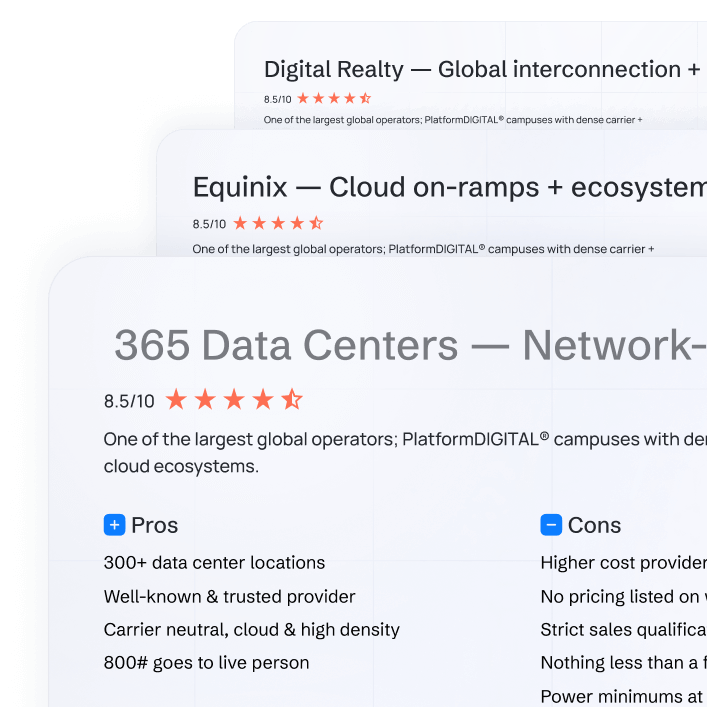
Instead of spending hours researching, calling, and negotiating with multiple providers, QuoteColo simplifies the process at no cost to you. Here’s how we help:
Tell Us Your Requirements
Share key details like your preferred location, power needs, rack space, bandwidth, security requirements, bandwidth demands, and budget.
We Identify the Best Matches
Our experts have an extensive network of trusted colocation providers across the U.S. We filter through the noise and present you with only the most relevant and reputable options that fit your specific needs.
Save Time and Money
With our industry connections and competive marketplace, we often secure better pricing and terms than you would get on your own. And best of all, our service is completely free to you with absolutely no obligation. This is why businesses trust www.quotecolo.com

Get Objective Comparisons
You receive a curated list of providers with transparent pricing, service levels, and contract terms—allowing you to make an informed decision without all the sales pressure.
Insider Knowledge
We know which providers deliver on their promises and which ones don’t.
Efficiency
You’ll get a shortlist of high-quality options quickly, without wasting time on endless calls and negotiations.
We Work for You, Not the Providers
Unlike sales reps who push their own company’s services, we are an independent resource that helps you find the most qualified solution.


If you’re trying colo for the first time with 2U–10U of gear, you’re in the weird middle zone:
This guide is how to describe your requirements clearly, understand what “no minimums” actually means, and send a request that gets you real pricing (not “let’s hop on a call”).
When you reach out to a data center (or broker), you’re basically answering: space + power + network + logistics + term.
Here’s the minimum viable spec for 2U–10U:
✅ Good: “Need 6U total, 2 servers (2U each) + 2 switches (1U each)”
This is the #1 reason quotes vary wildly.
You don’t need to be perfect. Just give a range:
✅ Good: “~600W average, 1.2kW peak for the whole stack.”
If you don’t know: add the PSU math + what circuits you want:
Don’t say “fast internet.” Say one of these:
✅ Good: “1Gbps port, metered, ~5–10TB/mo”
Also mention:
IPv4 is scarce and often gated. If you ask for 32 IPs with no reason, you’ll get ignored or upsold.
✅ Good:
If you’re unsure: ask for pricing tiers:
If you’re not local, say it clearly:
✅ Good: “Remote hands needed, please include hourly rate and typical response time.”
Facilities differ a lot on “small stuff” that becomes huge later:
✅ Good: “We’ll ship gear in. Need receiving + rack/stack help.”
This changes the quote more than people expect.
✅ Good: “Prefer 12 months, can sign quickly if pricing works. Need install within 2–3 weeks.”
Data centers throw around “no minimums,” but it usually means one of these:
Rule of thumb: if a provider can’t give ballpark pricing from a written spec, they’re not optimized for small deployments.
Subject: Colocation quote request (6U / ~1.2kW peak / 1Gbps / [City])
Hi — I’m looking for a colocation for a small deployment. Can you quote the following?
If you need anything else to quote, email is best. Thanks.
2U at 2kW is not the same as 10U at 400W. Power rules the bill.
You want to know if it’s:
If you’re just going to the internet, you may not need cross-connects yet. If you need cloud on-ramps or private connectivity later, ask what’s possible.
Some places have “remote hands” that’s basically: “we’ll reboot it… during business hours… maybe.”
You want expectations in writing.
Do I need A/B power for 2U–10U?
Not always. If your stack is small and you can tolerate a rare power event, single power might be fine. If it’s revenue-critical, A/B is worth pricing out—especially if you already have dual PSUs.
What’s a normal bandwidth choice for SMB colo?
A lot of first deployments start with 1Gbps and either metered TB or a modest commit. “Unmetered” can be great, but make sure you understand the port cap and cost.
How many IPv4 addresses do I really need?
Often fewer than you think. Many SMB setups do fine with 1–5 IPv4 plus IPv6. If you need more, explain why (many SSL sites, customer segregation, etc.).
Why do some providers ignore small requests?
Because their sales process is built for big racks and big spend. Small colo works best with providers that have a streamlined quoting workflow (or a broker who already knows who will actually quote).
