


AI colocation pricing is not a mystery, but most public numbers are incomplete or misleading. This post gives realistic GPU colocation cost ranges so you can decide early whether an AI server hosting cost fits your budget and if it’s worth getting quotes.
Why AI Infrastructure Cost Feels So Confusing
AI buyers don’t buy “one more rack,” they buy kW and bandwidth. Your real AI colocation pricing is driven by:
- Power density (kW per rack, not U size)
- Cooling model (air vs liquid‑ready vs liquid)
- Network (1/10/25/100G, commits and cross‑connects)
- Term, minimum commits and remote hands
Many data centers won’t publish real GPU colocation cost online, and those that do often show a base rack rate without the add‑ons that actually determine AI server hosting cost. That’s exactly the gap this article fills.
AI Colocation Pricing: Typical Power-Based Ranges
You can think of AI colocation in simple power bands – 5kW, 10kW, 20kW and “true HD” above that. These are all‑in cabinet-level ranges for US markets (rack + power + standard cooling + basic connectivity), based on current high‑density and GPU colocation pricing.
Power Density vs Typical Monthly Cost
| Density band (per rack) | What it usually powers | Typical monthly cost (USD) | Notes |
| 5kW | Modest GPU/CPU mix; early AI workloads | $800–1,500 | Often standard density in major metros. |
| 10kW | One dense GPU box or several mid‑range servers | $1,500–3,000 | Entry AI colocation pricing in power‑rich markets. |
| 20kW | Small GPU cluster, multiple nodes | $3,000–6,000 | “High density” in many traditional facilities. |
| 30kW | Production inference or small training rack | $4,500–8,000+ | Requires strong containment or RDHx; not universal. |
| 40kW | Heavy training rack, H100/Blackwell bundles | $6,000–11,000+ | Often liquid‑ready, higher $/kW in Ashburn/SV. |
Real deals sit at the intersection of market and density. A 10kW rack in Dallas can be cheaper than a 5kW rack in Manhattan‑adjacent New Jersey, even before you add GPUs.
AI Colocation Pricing by Market (kW-Based)
Below is a more “GPU‑aware” view: per‑kW ranges in key metros that are commonly used for AI server hosting.
| Market / Metro | Typical kW per AI rack | AI colocation pricing (USD per kW/mo) | Example: 20kW rack (USD/mo) |
| Ashburn / N. Virginia | 10–30kW | $180–300 | $3,600–6,000 |
| Dallas / Texas markets | 10–40kW | $140–240 | $2,800–4,800 |
| Phoenix / Arizona | 15–40kW | $130–220 | $2,600–4,400 |
| Pacific Northwest (OR/WA) | 15–50kW | $120–200 | $2,400–4,000 |
| Chicago | 10–25kW | $160–260 | $3,200–5,200 |
| New Jersey / NYC metro | 8–20kW | $170–280 | $3,400–5,600 |
| Silicon Valley / Bay Area | 10–25kW | $200–350 | $4,000–7,000 |
| N. & S. Dakota | 20–60kW | $100–170 | $2,000–3,400 |
Key takeaway: small shifts in market and kW band move AI colocation pricing by thousands per month per rack, which matters as soon as you have more than a single GPU box.
What’s Actually Inside AI Colocation Pricing?
Most AI buyers first see a “rack price,” then discover there’s a lot more to GPU colocation cost than one number.
Usually Included
- Committed power: 5–40kW (or more) per rack, typically billed at 80–100% of your contracted kW.
- Cabinet or cage space: Full rack (40–52U) in a shared room or private cage.
- Cooling baseline:
- Air / containment for 5–15kW and sometimes 20kW.
- Higher‑end sites may include “HD zones” with improved airflow.
- Network port: 1G or 10G included, often with a modest traffic commit or “fair use” model.
Often Not Included (But Can Add 20–60% to the Bill)
- Cross‑connects: $100–$400 per month each to clouds, IXs and carriers. AI heavy use often involves several.
- Remote / smart hands: $150–$300 per hour for GPU swaps, cabling, and general on‑site work.
- Setup fees: $500–$3,000 for install, cabling, and initial turn‑up.
- Burst bandwidth / 95th percentile: If your training runs spike, you may see overage charges.
- High density / liquid premiums: RDHx or liquid‑ready racks can add $500–$2,000 per rack per month at 30kW+.
The gap between the initial quote and actual AI server hosting cost often lands in the 20–60% range, depending mainly on cross‑connect count, bandwidth model and support usage. That’s where brokers earn their keep.
AI Colocation vs Cloud: When Does Colo Win?
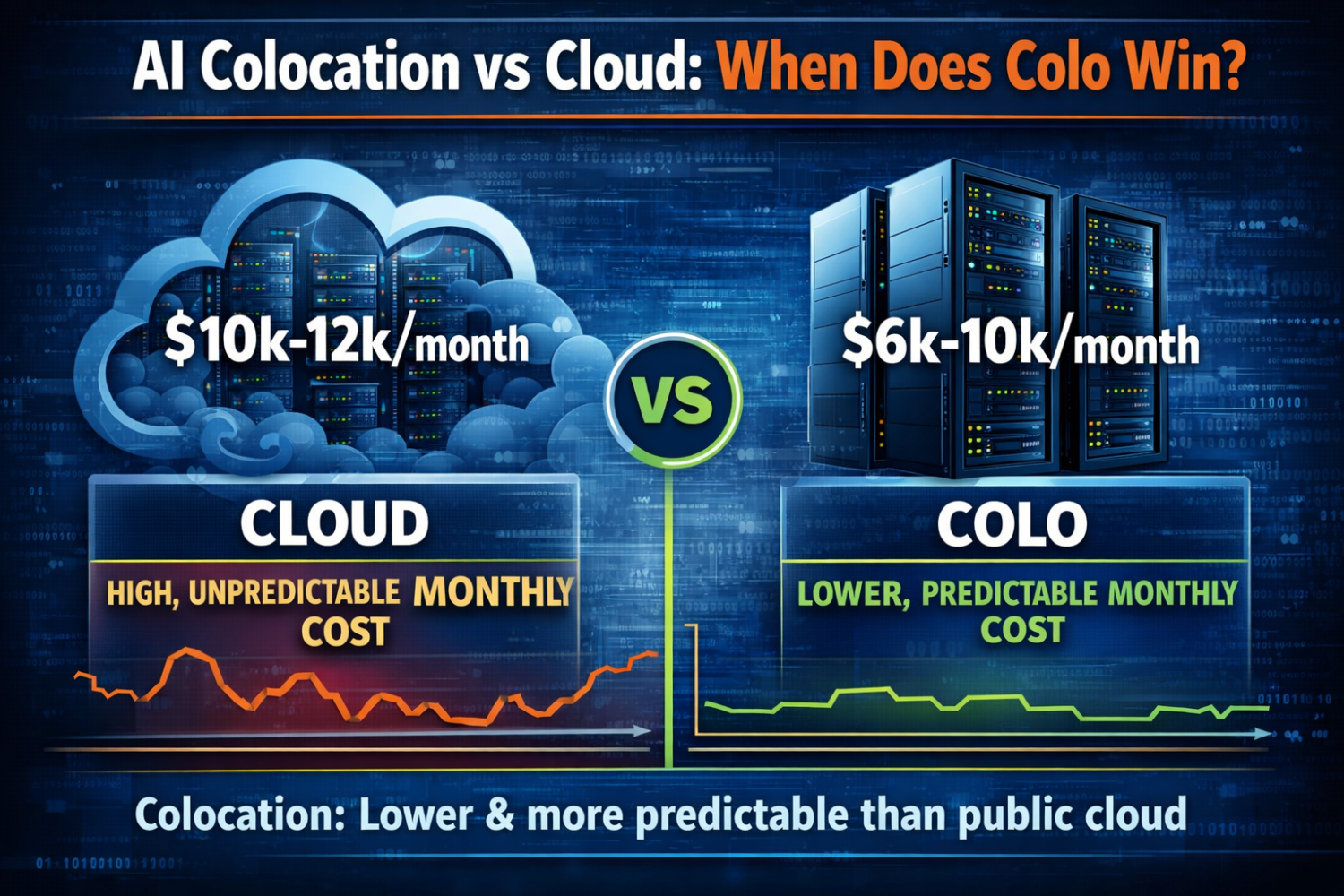
Many CTOs arrive at AI colocation only after a painful cloud bill. The pattern in 2024–2026 is consistent:
- Teams prototype in the cloud, where speed of spin‑up beats everything.
- Spend accelerates, especially for training‑heavy or always‑on inference.
- They move stable AI workloads (inference farms, recurring training jobs) into colocation for predictable TCO.
On a per‑rack basis, a 20kW H100 or L40S rack in colo might run $3,000–6,000/mo, whereas a similar amount of GPU capacity in major clouds can easily exceed that at moderate utilization once you factor in instance cost and egress.
The break‑even point depends on utilization and scale, but many GPU colocation deals become compelling once you:
- Run relatively consistent workloads
- Have >10–15kW worth of GPUs
- Can commit for at least 12–24 months
Practical AI Cost Scenarios
Scenario 1 – Single 10kW GPU Box (Entry AI)
- Hardware: 1 dense GPU server (8x mid‑range GPUs) drawing up to 10kW.
- Market: power‑sane metro like Dallas or Phoenix.
- Typical AI colocation pricing: $1,500–3,000/mo all‑in before bandwidth spikes.
This is where you prove value, burn down cloud bills and see if your AI infra justifies scaling.
Scenario 2 – 20kW Small GPU Cluster
- Hardware: 2–3 GPU servers, one 20kW rack.
- Market: Ashburn vs Dallas choice matters.
- Monthly GPU colocation cost (rack side):
- Dallas: ~$2,800–4,800 (20kW × $140–240/kW).
- Ashburn: ~$3,600–6,000 (20kW × $180–300/kW).
Add cross‑connects (say 2–4), remote hands and bandwidth, and the realistic spread becomes $3,500–7,000+ depending on design.
Scenario 3 – 40kW High-Density Rack (Training / Heavy Inference)
- Hardware: H100 or Blackwell‑class rack at 30–40kW.
- Market: Pacific Northwest vs Silicon Valley.
- Monthly AI server hosting cost (rack side):
- PNW: 40kW × $120–200 = $4,800–8,000.
- Bay Area: 40kW × $200–350 = $8,000–14,000.
If you’re training heavily and hitting the network hard, the network design (private links vs public internet, locality to data) can swing your bill as much as the choice of metro.
The Real Levers Behind GPU Colocation Cost
From QuoteColo’s vantage point, the biggest cost levers for AI colocation pricing are:
- Market selection: Ashburn, Dallas, Phoenix, PNW, and cheap‑power states vs hyper‑premium metros like SV/NYC.
- Power density band: Staying at 10–20kW vs jumping to 30–40kW changes cooling and $/kW.
- Term & minimums: 12 vs 36 months, and whether the provider demands 100kW+ minimums.
- Cooling path: Air only vs HD containment vs liquid‑ready vs actual liquid.
- Network pattern: Number of cross‑connects, commit levels and whether you need 25/100G.
Good brokers will show you how each lever shifts AI colocation pricing in real numbers, not just “this market is expensive”.
Why Use a Broker for AI Infrastructure Cost?
AI infra buyers in 2026 typically:
- Learn concepts via AI tools.
- Validate via Google and provider sites.
- Turn to brokers when they hit opaque pricing and power availability walls.
Working directly with 10–20 data centers is slow and rarely gives you a full market view. Brokers like QuoteColo:
- Know which providers still accept 5–50kW GPU clusters without MW minimums.
- See actual deal pricing and how bills differ from public rates in each market.
- Can compare committed kW vs metered power models, bandwidth billing, and cross‑connect fees side‑by‑side.
On average, that kind of coverage and leverage can save 10–25% on AI server hosting cost, especially on high‑density or niche deployments.
Why Choose Us
- 500+ Hosting Colocation Facilities
- 10% OFF Avg. annual savings
- Trusted service since 2004


Get A Quote
Describe your specs and needs and and we’ll email you 3-5 options with pricing and terms from providers that match. Free. No sales calls
Simple Checklist Before You Get AI Colocation Quotes
If you want fast, accurate numbers on AI colocation pricing, have these ready:
- Target kW per rack and total kW (now and 12–24 months out).
- Markets you can live with (e.g., “prefer Ashburn, will consider Dallas or PNW if cost is better”).
- Cooling tolerance (air only vs willing to consider liquid‑ready).
- Network requirements (1/10/25/100G, cloud on‑ramp needs).
- Term flexibility (can you commit for 12–24 months?).
If you share those few data points, a broker can often narrow the field to 3–5 realistic options in 24–48 hours instead of you spending weeks on sales calls.
If you had to pick today, which density band fits your AI deployment best – around 5–10kW, 20kW, or closer to 30–40kW per rack?


