


Wholesale colocation and retail colocation are not two names for the same service. They solve different infrastructure problems, and the wrong fit usually shows up in one of three places: contract size, deployment timeline, or the real monthly bill. If you are looking for colocation in 2026, the useful question is not which model sounds more “enterprise.” It is whether your deployment is better served by renting cabinets inside a shared environment or by taking down dedicated space with a much larger power commitment.
For most buyers, the dividing line is not just rack count. It is power, term length, growth certainty, and how much infrastructure you are ready to commit to in one move.
What is the difference between retail and wholesale colocation?
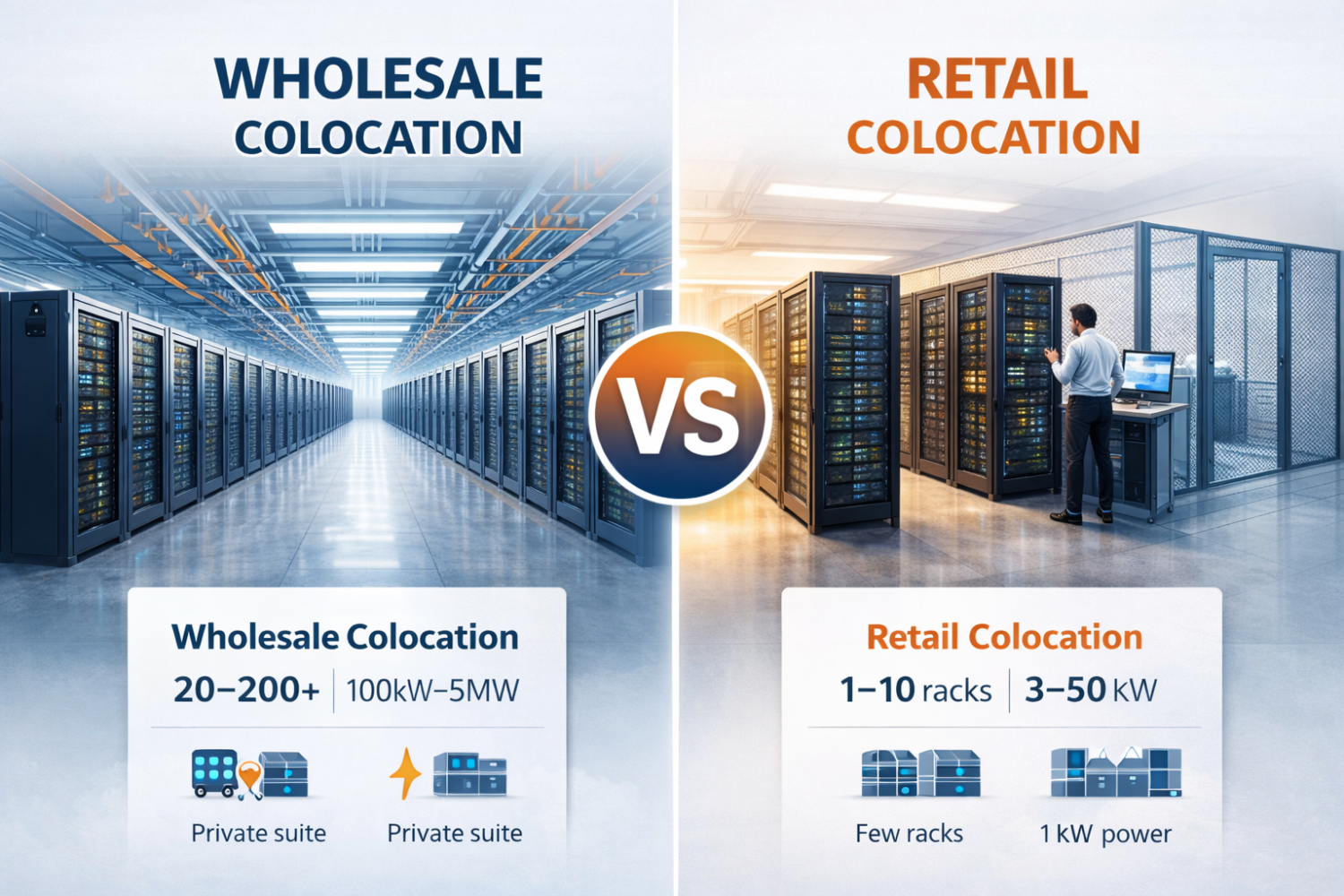
Retail colocation is the rack-by-rack model. You lease a defined amount of space inside a shared data center environment, usually from a few U to several cabinets or a private cage. The provider supplies power, cooling, network access, physical security, and remote hands, and you install your own hardware.
Wholesale colocation is closer to leasing a private data center suite inside a larger facility. Instead of buying cabinets one at a time, you commit to a larger power block and a dedicated space model. That usually means longer contracts, more design coordination, and more infrastructure planning before you ever roll in the first rack.
The simple version looks like this:
| Factor | Retail colocation | Wholesale colocation |
| Typical footprint | 1 rack to a small cage | Large cage, private suite, or dedicated hall space |
| Typical power commitment | From small sub-rack needs up to tens of kW | Usually starts around 100 kW and scales into MW territory |
| Space model | Shared floor, cabinets, or smaller private cages | Dedicated suites or major reserved sections |
| Contract structure | Shorter and more flexible by colo standards | Longer and more capacity-driven |
| Deployment speed | Faster to start if capacity exists | Slower, because planning and power delivery matter more |
What does retail colocation actually look like?
Retail colocation is the model most teams mean when they say they are looking for colo. A company might need one cabinet in Ashburn, four racks in Dallas, or a cage for a compliance-sensitive workload in Chicago. The deployment is still serious, but it is not large enough to justify taking down a private suite with a major power reservation.
Typical retail buyers include:
- SaaS teams moving predictable workloads out of cloud.
- Infrastructure teams placing regional hardware in multiple metros.
- Companies that need one to ten racks with clear network and power requirements.
- Smaller AI or analytics deployments that need careful facility filtering.
- Compliance-driven teams that need physical controls without taking on a wholesale footprint.
Retail colocation works well because it lets you buy only what you need now. That matters when the growth path is real, but not fully proven.
What does wholesale colocation actually look like?
Wholesale colocation is for buyers with larger, more predictable infrastructure demand. These are not usually exploratory deployments. They are capacity programs. The buyer often knows the target market, the power target, the rack plan, and the term horizon before the search even starts.
A wholesale search usually involves:
- A larger minimum power commitment.
- Dedicated suites or reserved halls.
- Longer contract terms.
- More design and implementation planning.
- Closer review of energization timelines and expansion rights.
That is why wholesale is usually chosen by larger SaaS platforms, major hosting providers, bigger AI infrastructure deployments, and enterprises consolidating multiple environments into one larger footprint.
Is the real dividing line rack count or power?
Power matters more. Rack count is easy to say out loud, but it does not tell you enough. Twenty racks at 5 kW each is one kind of search. Twenty racks at 20 kW each is another. The second search cuts the market down much faster, even if the floor plan looks similar on paper.
That is especially relevant in 2026. North America colocation vacancy was about 1.4% in CBRE Q1 2026 data, and about 92% of capacity under construction was pre-leased before completion. In that market, the hard part is often not finding a building. It is finding usable power on the right timeline.
If your team leads with “we need 30 racks,” that is incomplete. A better starting point is:
- required kW
- peak versus sustained load
- cooling requirement
- target metro
- network model
- term length
- growth path
That is the information that decides whether retail still works or whether the search has already crossed into wholesale territory.
When is retail colocation the better choice?
Retail colocation is usually the better fit when your deployment is still growing, your power requirement is meaningful but not massive, or you need flexibility more than you need a private suite on day one.
Retail often makes sense when:
- You are deploying one rack to a modest multi-rack footprint.
- You want to scale gradually instead of taking down a large block of capacity upfront.
- You are testing a market, an application footprint, or a cloud repatriation model.
- You need faster time to deployment than a wholesale build path usually allows.
- You need smaller, cleaner like-for-like provider comparisons.
It is also the right entry point for many teams that eventually grow into wholesale. That progression is normal. The expensive mistake is not starting with retail. It is forcing wholesale economics onto a deployment that has not earned them yet.
Why Choose Us
- Access to 500+ Hosting Colocation Facilities
- Get prices within hours vs weeks
- Trusted Service Since 2004


Get Free Quotes From Providers
Free qualified quotes in your inbox within hours vs weeks. No sales calls until you’re ready.
When is wholesale colocation the better choice?
Wholesale becomes more attractive when the deployment is large enough that the buyer benefits from a dedicated space model and a larger negotiated power block. At that point, the operational complexity is justified by the scale.
Wholesale often makes sense when:
- Your power commitment starts around 100 kW and grows from there.
- You want dedicated suites or a more controlled private environment.
- You have a clear multi-year infrastructure plan.
- You need stronger expansion rights and long-term capacity certainty.
- You are consolidating infrastructure rather than experimenting with it.
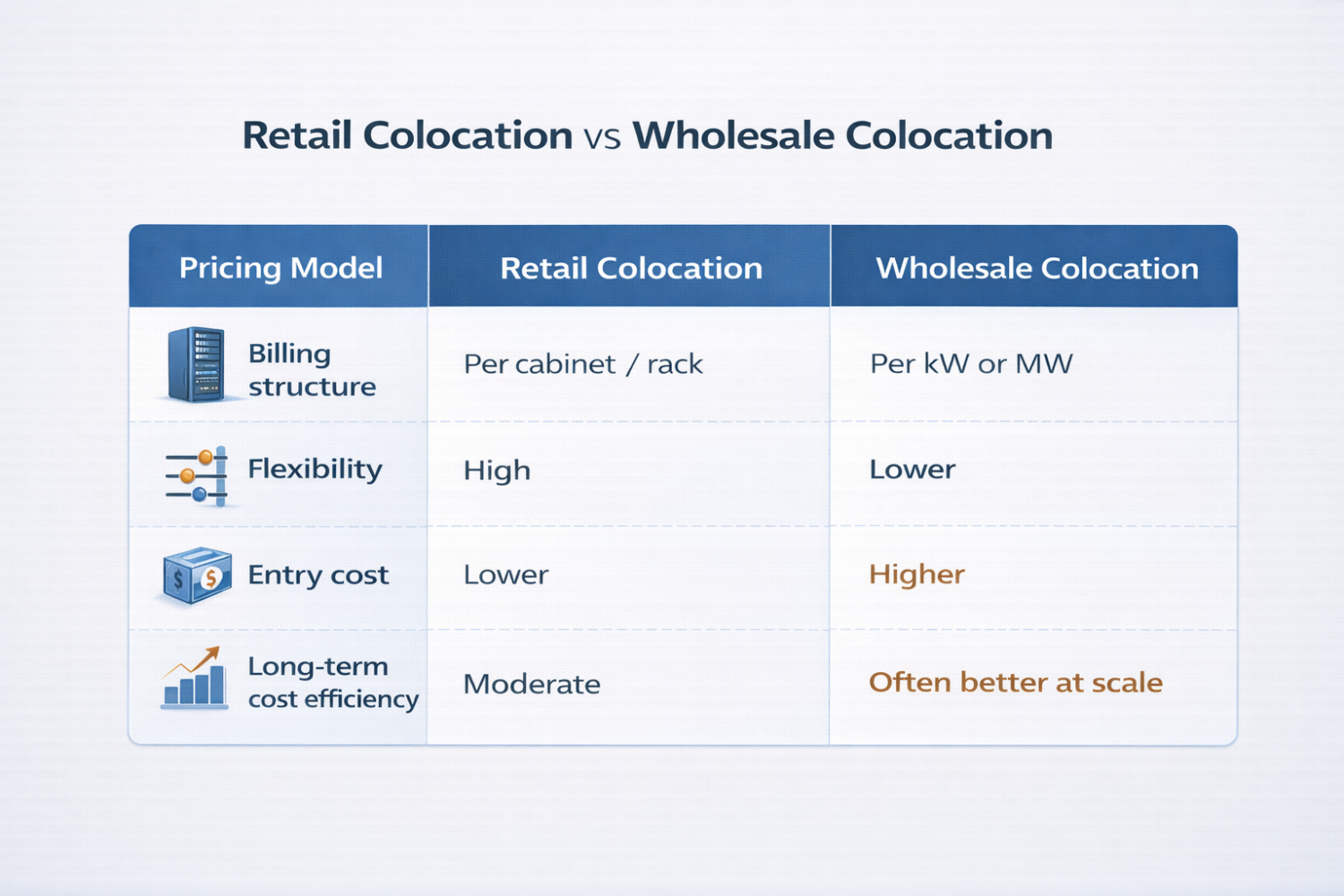
Wholesale is not automatically cheaper just because it is bigger. It is usually more cost-efficient only when the larger commitment is actually used and the term structure matches the workload reality.
How do the pricing models differ?
Retail and wholesale are priced differently because the seller is taking a different kind of risk in each case.
Retail pricing usually feels more cabinet-oriented. Even when the quote is shaped around power, the buyer often thinks in cabinets, cages, and recurring monthly charges tied to a smaller footprint.
Wholesale pricing is more capacity-oriented. Power commitment, reserved growth, private-space design, and longer term structure tend to drive the economics harder than rack-by-rack comparison.
In both models, the first number is rarely enough. You still need to check:
- power model
- cross-connect fees
- remote hands rates
- install and non-recurring charges
- annual escalators
- bandwidth structure
- expansion rights
That is one reason buyers get tripped up. They compare a retail quote and a wholesale quote as if both are fully loaded, when each may be hiding different assumptions.
Why do some companies start in retail and move to wholesale later?
Because infrastructure growth is rarely linear on paper, even when it looks linear in a planning deck. Many teams do not know on day one whether they will stop at four racks, grow to twelve, or need a dedicated suite in two years.
Retail gives those teams a cleaner way to start:
- lower initial commitment
- easier market entry
- time to validate actual power draw
- time to validate network and support requirements
- time to prove the workload belongs in colo at all
Once the environment becomes large enough and predictable enough, wholesale starts to make more sense. The move is usually driven by utilization, not by branding. A team does not graduate to wholesale because it sounds more advanced. It gets there because the numbers and the operating model now support it.
Where buyers usually waste time
The waste usually starts before the first quote comes back. Teams often search by brand, city, or generic category before defining the deployment tightly enough. That produces two common problems:
- They compare providers that were never pricing the same thing.
- They spend weeks with facilities that were never viable on power, term, or footprint.
The market still does not help much. Providers often do not publish real pricing, live capacity, or the contract details that drive the bill. Search engines and LLMs can show you names. They cannot tell you which site actually has the power block you need right now, or which one looks competitive until cross-connects and escalators show up in the contract.
Where QuoteColo fits in
QuoteColo is a broker and referral service, not a data center operator. Since 2004, we have helped buyers turn one requirement set into a shortlist of matched providers instead of forcing them through a long round of disconnected sales calls.
That matters in both retail and wholesale searches, but for slightly different reasons.
In retail, we help buyers compare providers on a true like-for-like basis and avoid paying attention to quotes that were scoped loosely.
In wholesale, we help buyers focus on the smaller subset of providers that can actually support the power commitment, timeline, and growth model in the target market.
We work with 500+ providers, the service is free to buyers, and the buyer’s price is not marked up because providers pay the referral fee.
FAQ
What is retail colocation?
Retail colocation is the most common form of colo. You lease a defined amount of cabinet or cage space inside a shared data center environment, and the provider supplies the surrounding infrastructure such as power, cooling, connectivity, and physical security.
What is wholesale colocation?
Wholesale colocation is a larger-capacity model where the buyer commits to a much bigger power block and usually takes dedicated space such as a private suite. It is built for larger, longer-horizon infrastructure programs.
How many racks count as wholesale colocation?
There is no single universal threshold, which is why rack count alone is a weak filter. In practice, wholesale starts to become relevant when the total power commitment and private-space requirement move beyond a normal multi-rack retail deployment. Power is usually the better signal than cabinet count.
Is wholesale colocation cheaper than retail colocation?
It can be at larger scale, but only when the deployment is large enough to justify the commitment. Wholesale economics improve when a buyer can use the reserved capacity and operate within the longer contract structure. If the footprint is still uncertain, retail may be the more efficient decision even if the unit economics look less aggressive on paper.
Can a company start with retail and move to wholesale later?
Yes, and many do. That is often the cleanest path when the workload is growing but not yet big enough to justify a wholesale suite. The move usually happens when power demand, rack growth, and contract certainty become easier to forecast.
What should a buyer define before comparing providers?
Start with usable kW, peak versus sustained load, target metro, bandwidth model, compliance requirements, timeline, term preference, and growth path. Once those are clear, it becomes much easier to tell whether the deployment belongs in retail colocation or wholesale colocation.
Start with the real requirement
If you are looking for colocation, do not start with the label alone. Start with the spec. Define the footprint, power target, target market, network needs, compliance requirements, and timeline. That will tell you much faster whether retail or wholesale is the better model.
If you already have that spec, QuoteColo can match it to providers that fit and return a shortlist with real pricing, typically within hours by email. That is usually a better use of time than spending weeks trying to normalize quotes that were never built from the same assumptions.


