
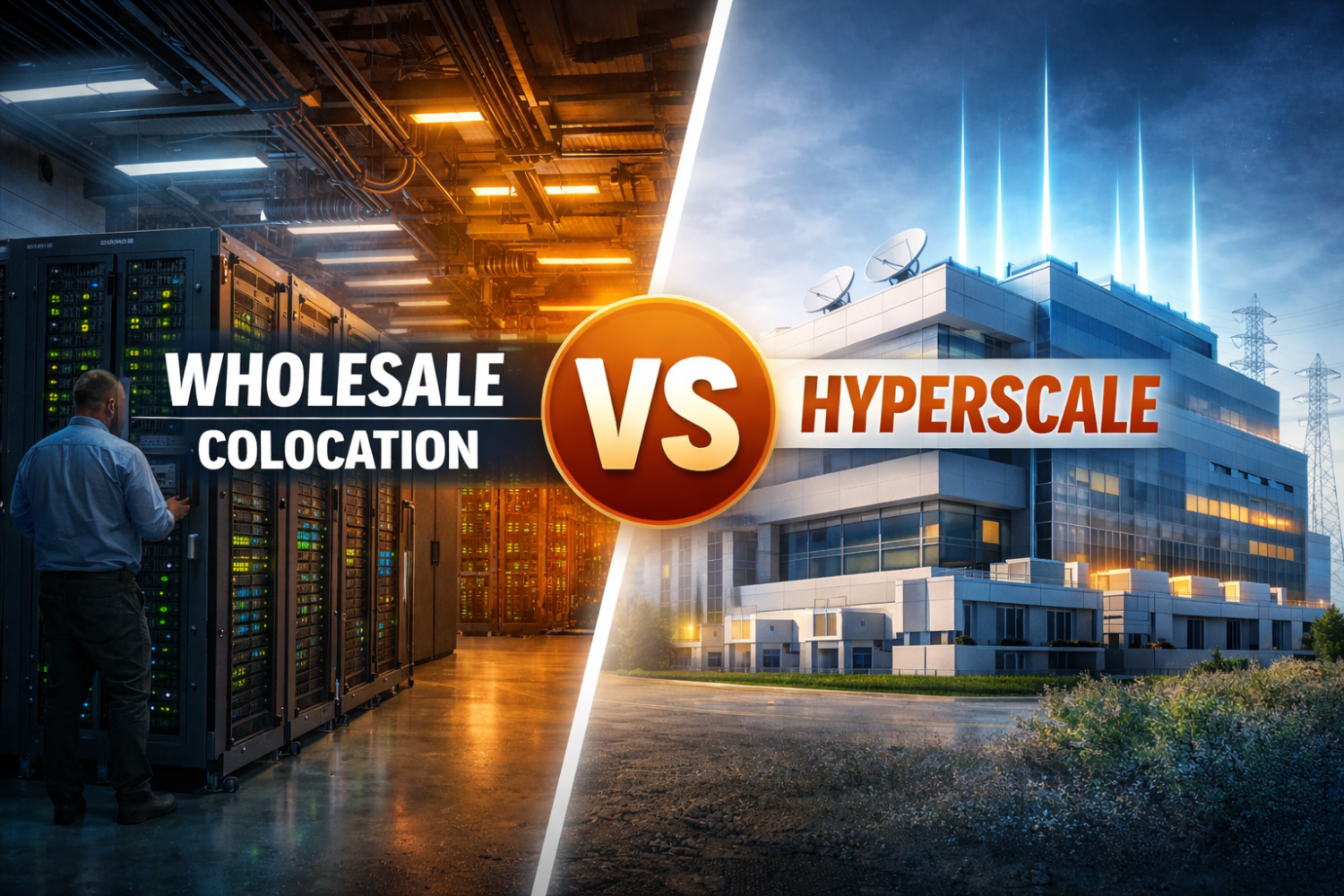

If you’re looking for large-scale colocation infrastructure, you’ll quickly run into two terms that sound similar but represent very different parts of the data center market:
Wholesale colocation and hyperscale data centers.
Both involve large facilities and significant power capacity, but they serve different customers, operate under different economic models, and support very different infrastructure strategies.
Understanding the difference can save infrastructure teams months of procurement friction and help avoid costly deployment mistakes.
In this article we’ll explain:
- What wholesale colocation actually means
- How hyperscale data centers operate
- Typical power and rack deployment sizes
- When enterprises choose wholesale instead of hyperscale
What Is Wholesale Colocation?

Wholesale colocation refers to leasing large blocks of space and power inside a data center for your own infrastructure.
Instead of renting a single cabinet or rack like in retail colocation, companies lease entire suites or sections of a facility. The customer installs and manages their own servers, networking equipment, and storage systems, while the data center operator provides the building, power infrastructure, cooling, and physical security.
Typical wholesale deployments are significantly larger than traditional colocation environments.
Typical Wholesale Colocation Specifications
| Specification | Typical Range |
| Rack count | 20 – 200+ racks |
| Power density | 5 – 15 kW per rack |
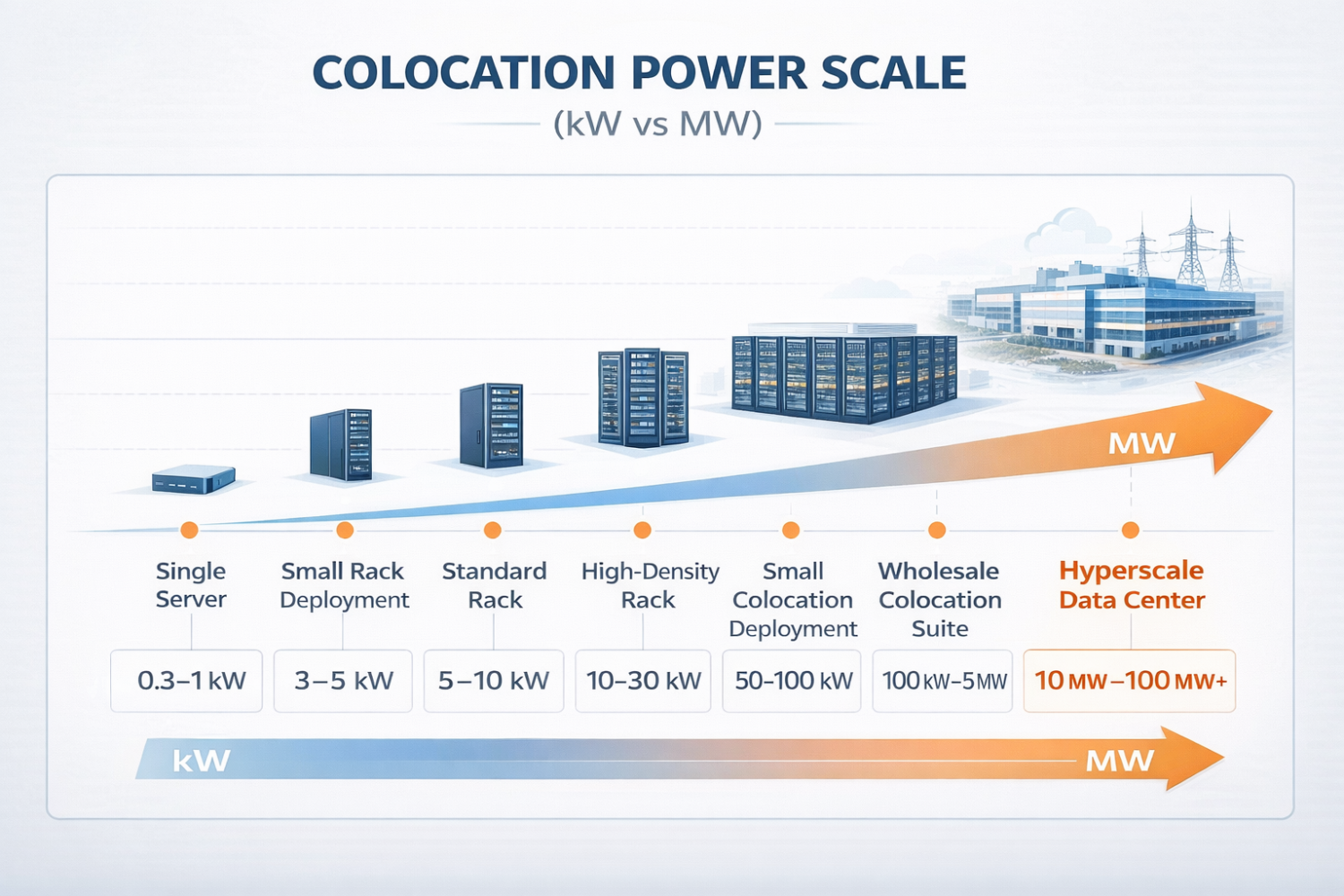
| Total power | 250 kW – 5 MW |
| Connectivity | 10G – 100G |
| Contract terms | 3 – 10 years |
For many companies, wholesale colocation feels similar to leasing a private data center inside a larger facility.
Organizations that commonly use this model include:
- SaaS platforms running global applications
- Enterprise IT teams consolidating infrastructure
- Content platforms and hosting providers
- AI or analytics workloads with high compute density
Many deployments appear in well-established infrastructure markets such as Ashburn (Northern Virginia), Dallas, Phoenix, Chicago, and Atlanta, where strong carrier ecosystems already exist.
What Is a Hyperscale Data Center?

A hyperscale data center is designed for infrastructure at an entirely different level of scale.
These facilities are built to support global cloud platforms and massive internet services operated by companies such as Amazon, Microsoft, Google, and Meta.
Instead of leasing suites inside a shared facility, hyperscale deployments often involve entire buildings or large campuses. These environments are designed around proprietary hardware, networking architectures, and automation systems optimized for extremely large distributed workloads.
Typical Hyperscale Deployment Scale
| Metric | Hyperscale Environment |
| Power capacity | 10 – 100+ MW |
| Server count | Hundreds of thousands |
| Deployment type | Entire buildings or campuses |
| Infrastructure control | Fully customized |
To put this into perspective: a large enterprise wholesale deployment might require a few megawatts of capacity, while hyperscale campuses regularly operate at tens of megawatts or more.
Wholesale vs Hyperscale: Key Differences
Although both models involve large data center infrastructure, the customers and operational goals are fundamentally different.
| Feature | Wholesale Colocation | Hyperscale |
| Typical customer | Enterprises / SaaS companies | Cloud providers |
| Deployment size | 250 kW – 5 MW | 10 – 100+ MW |
| Space model | Dedicated suites | Entire facilities |
| Hardware ownership | Customer infrastructure | Hyperscaler infrastructure |
| Flexibility | High | Highly specialized |
Wholesale colocation provides flexibility for organizations running their own infrastructure, while hyperscale environments are designed for companies operating massive cloud platforms.
Why Many Companies Choose Wholesale Colocation
For many CTOs and infrastructure leaders, wholesale colocation represents the middle ground between building a private data center and relying entirely on public cloud.
One major driver behind this trend is cost control. Over the last few years many organizations have realized that certain workloads become expensive when run exclusively in the cloud. High data transfer volumes, GPU workloads, and large analytics clusters can generate unpredictable cloud bills.
Moving these workloads into colocation allows companies to regain control over long-term infrastructure costs.
Another important factor is network flexibility. Many wholesale colocation facilities operate as carrier-neutral datacenters, meaning customers can choose from multiple connectivity providers and cloud on-ramps.
This allows companies to build infrastructure architectures that combine colocation and cloud environments.
Typical connectivity options include:
- 1 Gbps ports for smaller deployments
- 10 Gbps and 40 Gbps links for application traffic
- 100 Gbps connections for large-scale infrastructure
These environments are particularly attractive for SaaS platforms and global applications that need low latency and flexible interconnection options.
The Reality of the Colocation Market in 2026
One reality infrastructure teams often discover late in the process is that finding large-scale colocation capacity has become more difficult.
In many major markets the primary constraint is no longer floor space — it’s power availability.
Many facilities face:
- limited power capacity for new deployments
- longer installation timelines
- minimum commit requirements for larger customers
Another challenge is pricing transparency. Most providers do not publish pricing for large deployments. Variables such as power billing models, cross-connect costs, remote hands pricing, and contract escalators can vary widely between facilities.
Because of this, many companies spend weeks contacting providers individually just to determine which data centers can support their deployment.
QuoteColo helps simplify this process by delivering shortlists of qualified colocation providers with pricing and availability, often saving organizations significant time during the procurement process. Companies comparing multiple providers through the platform frequently discover cost differences that average roughly 10% in annual infrastructure savings.
Why Choose Us
- Access to 500+ Hosting Colocation Facilities
- Get prices within hours vs weeks
- Trusted Service Since 2004


Get Free Quotes From Providers
Free qualified quotes in your inbox within hours vs weeks. No sales calls until you’re ready.
Why Hyperscale Isn’t an Option for Most Companies
Because hyperscale infrastructure receives so much attention in the tech industry, many infrastructure teams initially assume it might be relevant for their deployment.
In practice, hyperscale facilities operate at a scale that makes them inaccessible for most organizations.
Typical hyperscale deployments require:
- massive power commitments (often 10+ MW)
- highly customized infrastructure environments
- multi-year infrastructure planning cycles
Even large SaaS companies rarely reach this scale.
Instead, they deploy infrastructure across several wholesale colocation facilities in strategic markets, building redundancy and geographic diversity into their architecture.
When Wholesale Colocation Makes the Most Sense
Wholesale colocation becomes particularly attractive when companies are deploying significant infrastructure capacity and want predictable costs and network flexibility.
It is commonly used for environments such as:
- SaaS application infrastructure
- private cloud platforms
- AI and analytics clusters
- multi-region disaster recovery deployments
These deployments often involve dozens or hundreds of racks and power densities between 5 and 15 kW per rack, depending on the hardware involved.
How to choose the right colocation (4 Options)
Finding the right colocation provider can take time because many data centers don’t publish pricing and power availability varies by market. Companies usually use one of these four approaches:
1. Contact Data Centers Yourself
You can research providers on Google and contact them directly. This works, but it often requires many calls and emails before you find facilities that match your power, pricing, and space requirements.
2. Hire IT Consultants
Infrastructure consultants can help design architecture and recommend data centers. This option works well for large enterprise deployments, but consulting services can be expensive.
3. Ask Colleagues or Industry Peers
Many teams ask colleagues which datacenters or colo providers they use. This can provide useful insights, but one company’s provider may not fit another company’s power, location, or connectivity needs.
4. Work Through a Broker Like QuoteColo
Colocation brokers compare multiple providers for you. Instead of contacting facilities individually, you receive a shortlist of qualified data centers with pricing and availability, which can save significant time when evaluating options.
How QuoteColo Helps Companies Find the Right Colocation
Large colocation deployments involve a surprising number of variables.
Infrastructure teams must compare factors such as:
- kW pricing models
- A+B redundant power availability
- bandwidth pricing and commit levels
- cross-connect costs
- remote hands support and SLAs
- installation timelines
Because providers rarely publish this information publicly, evaluating multiple facilities can require weeks of calls and technical discussions.
QuoteColo helps companies simplify this process by identifying providers that match specific requirements and delivering shortlists of qualified datacenter options with real pricing and availability.
Why Choose Us
- Access to 500+ Hosting Colocation Facilities
- Get prices within hours vs weeks
- Trusted Service Since 2004
Get Free Quotes From Providers
Free qualified quotes in your inbox within hours vs weeks. No sales calls until you’re ready.
FAQ
What is wholesale colocation?
Wholesale colocation refers to leasing large sections of a data center, typically starting around 100 kW of power or dozens of racks, for deploying your own infrastructure.
What is a hyperscale data center?
Hyperscale data centers are massive facilities designed for global cloud platforms such as AWS, Google Cloud, and Microsoft Azure.
How many racks qualify as wholesale colocation?
Wholesale deployments typically start at 20–50 racks and several hundred kilowatts of power.
Is wholesale colocation cheaper than public cloud?
For large, predictable workloads it often is. Many organizations move compute-heavy infrastructure to colocation to gain more predictable costs.


