


If you’re a CTO in 2026 and your AWS/Azure/GCP bill makes your CFO sigh… you’re not alone.
The phrase we hear weekly:
“Cloud egress is killing us.”
Cloud isn’t “bad.” It’s incredible for speed, elasticity, and global reach.
But once workloads stabilize — SaaS platforms, analytics clusters, media distribution, backups — the math starts to look different.
This is your practical playbook for:
- Where cloud bills actually hide
- When colocation wins
- What inputs actually matter when comparing TCO
- How to avoid trading one opaque bill for another
No hype. Just math.
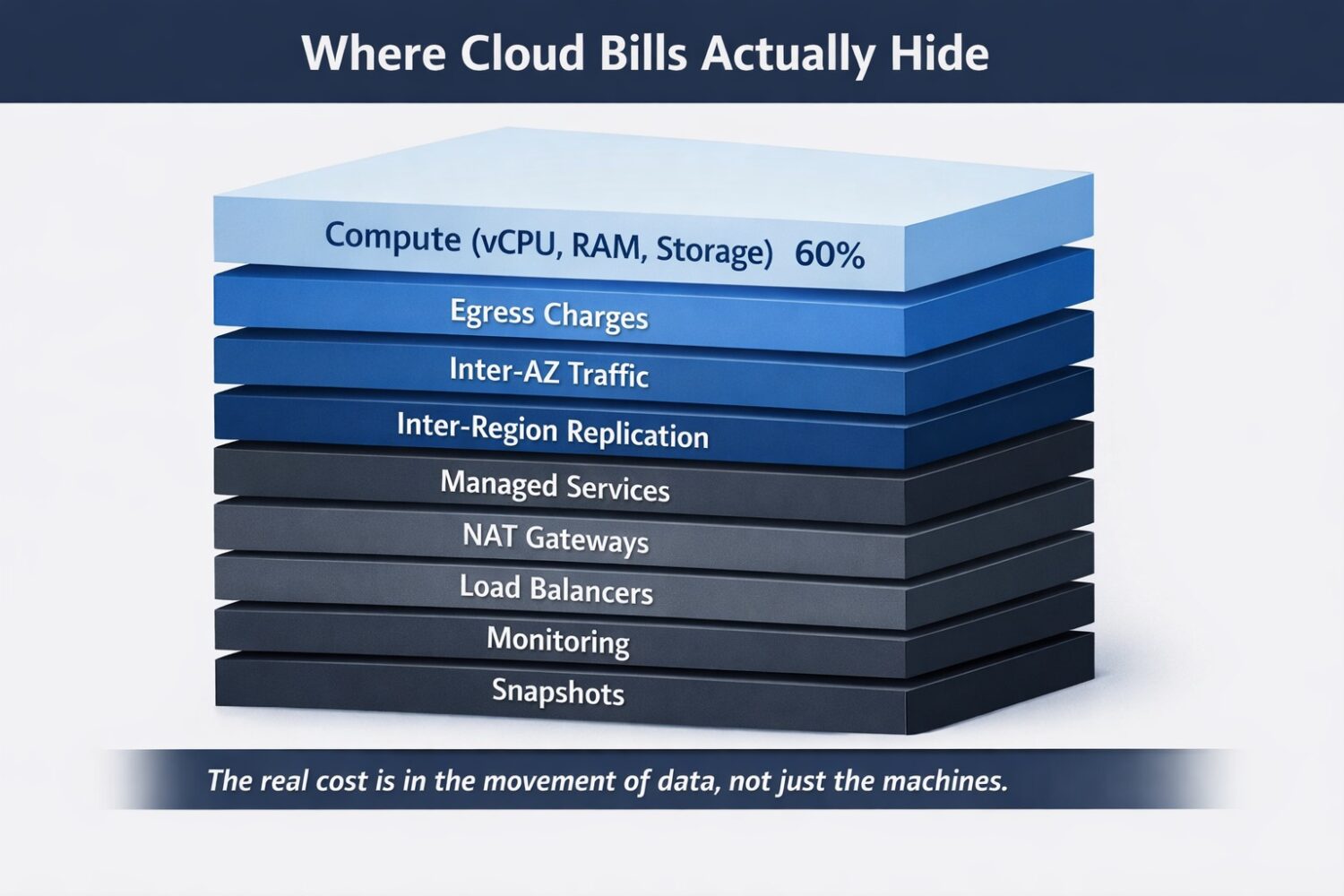
Where Cloud Bills Hide (It’s Not Just Compute)
Most CTOs think they’re paying for:
- vCPU
- RAM
- Storage
That’s about 60% of the story.
Here’s where cost creep really happens:
Egress (The Silent Multiplier)
Inbound is free.
Outbound is not.
Examples:
- Customer downloads
- CDN origin pulls
- Cross-region replication
- Hybrid traffic back to office or colo
- Inter-cloud transfers
The brutal part?
Egress often scales with revenue.
If you’re moving 100–300TB/month out of a cloud region, the line item gets loud — fast.
Managed Services Creep
This one sneaks up on fast-growing SaaS teams:
- Managed DB premiums
- Load balancers
- NAT gateways
- Backup snapshots
- Object storage tier shifts
- Monitoring add-ons
- Inter-AZ data transfer
Individually? Fine.
Collectively? A second infrastructure layer.
You wake up 18 months later paying for architecture decisions made when you had 1/10th the traffic.
Inter-Region & Inter-AZ Traffic
Redundancy is good.
Redundancy inside cloud can be expensive.
Cross-AZ traffic isn’t free.
Cross-region replication isn’t free.
Private links aren’t free.
Cloud pricing rewards consolidation — but high availability pushes you the other direction.
When Colocation Starts Winning
Colocation doesn’t win everywhere.
It wins when:
- Workloads are predictable
- Traffic volume is high
- You’re pushing serious egress
- You don’t need elastic scale every hour
- Hardware efficiency beats VM abstraction
Typical profiles where colo math flips:
| Profile | Why Colo Wins |
| SaaS with heavy downloads | Egress flattening |
| Media platforms | Predictable bandwidth cost |
| Analytics / AI inference | Hardware efficiency |
| Hybrid enterprise | Private cross-connect control |
| Mature startup (Series B+) | Stable capacity planning |
If you’re running steady-state workloads 24/7, cloud elasticity becomes an expensive luxury.
Get Quotes in a few hours
“For CTOs and technical teams looking for the right colocation partner, QuoteColo is the efficient way to get there. We deliver vendor-neutral options across the U.S., with transparent pricing and zero sales pressure.
Tell us your location, rack size (U), kW requirements, bandwidth model, and budget — and we’ll send back a curated shortlist with real pricing and clear terms. Fast. Free. No obligation. No endless discovery calls.
On average, clients save 15% compared to list pricing, and over the past 12 years we’ve helped 750+ companies secure the right colocation solution with less friction and better economics.

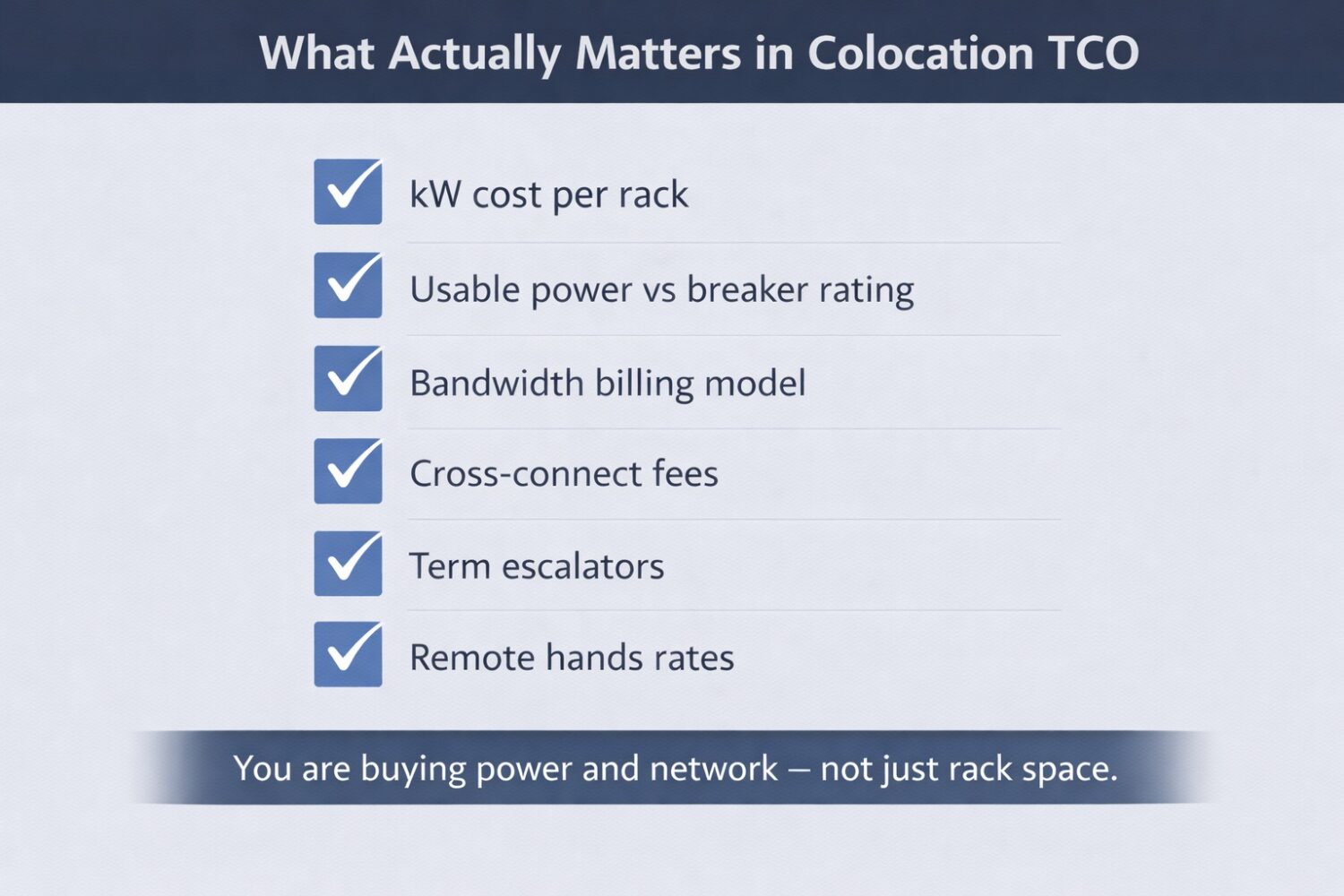
The Inputs That Actually Matter (Colo TCO)
If you’re evaluating colocation, ignore marketing brochures. Focus on these 5 variables:
- kW Cost (Power is the Core Metric)
Everything flows from power.
- Cost per kW
- Usable kW (not theoretical breaker capacity)
- A/B power requirement
- Voltage / amperage
- Density caps
You’re not buying “rack space.”
You’re buying power + cooling capacity.
In many metros, power cost variation between providers can swing 15–30%.
2. Bandwidth Model (Commit vs Burst vs Unmetered)
This replaces cloud egress unpredictability.
You must define:
- Port size (1G / 10G / 100G)
- Commit level (if any)
- Metered vs unmetered
- 95th percentile billing?
- Overage rate?
Colo bandwidth pricing is wildly different depending on model.
Example:
- 10G unmetered ≠ 10G port with 1G commit
This is where inexperienced buyers overspend.
3. Cross-Connect / MMR Fees
If you need:
- Cloud on-ramps
- Carrier diversity
- Private connectivity
- Exchange fabric access
Cross-connect math matters.
Each one:
- Has install fee
- Has monthly recurring fee
- May have meet-me-room policy quirks
Multi-site infra directors care deeply about this line item.
4. Term & Escalators
This is the “quiet cloud tax” equivalent in colo.
Ask:
- 12 vs 24 vs 36 month pricing delta
- Annual escalator %
- Ramp pricing?
- Early termination flexibility?
A 3% escalator compounded over 36 months changes TCO.
And yes — 12-month options exist if you know where to look.
5. Remote Hands + Operational Friction
Hidden friction costs:
- Hourly rate
- SLA
- After-hours premiums
- Receiving policies
- Install lead times
Cheap rack + expensive remote hands = fake savings.
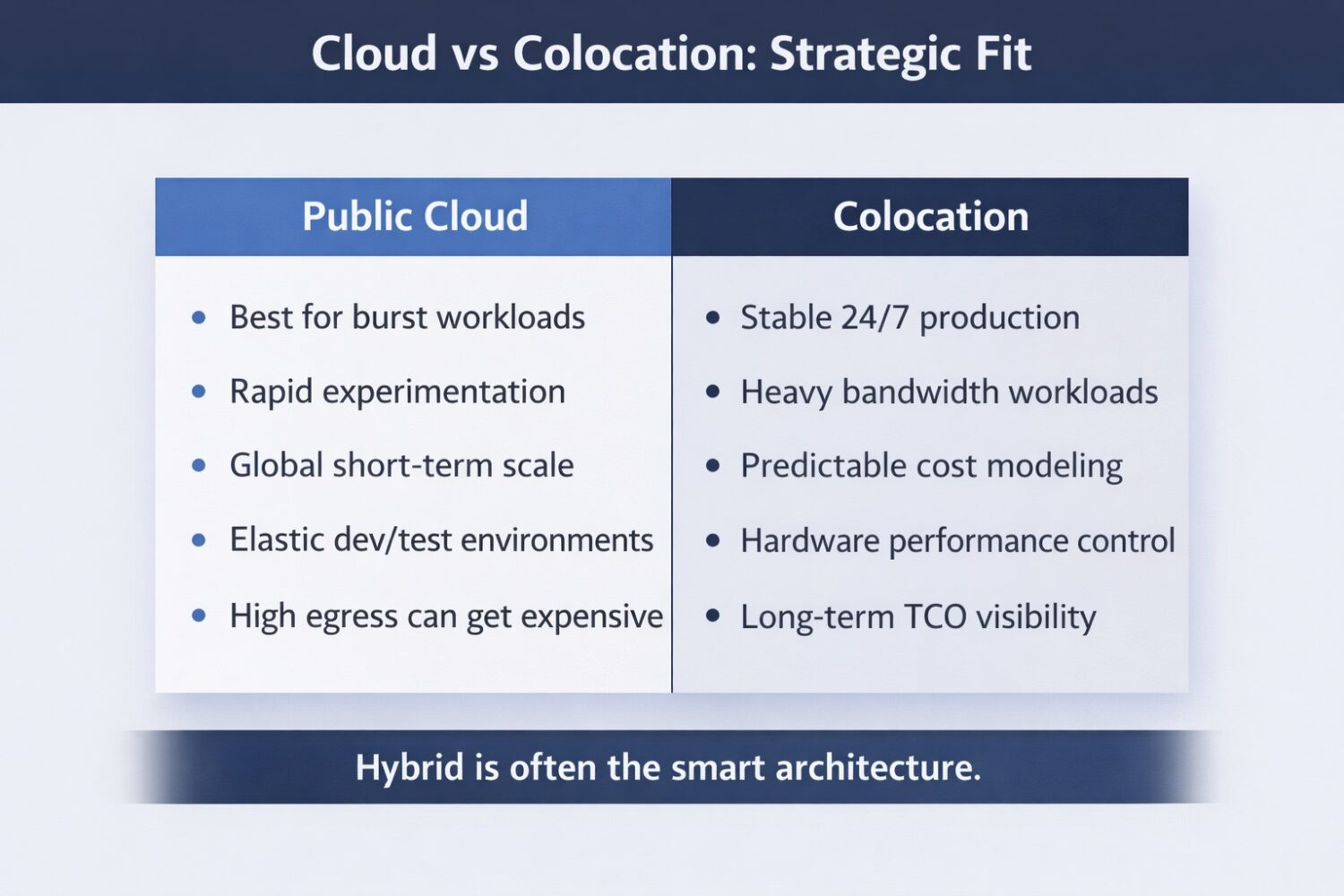
Cloud vs Colo: A Simple Strategic Model
Think of it like this:
| Layer | Best Home |
| Bursty dev/test | Cloud |
| Stable production | Colo |
| GPU cluster (steady inference) | Colo |
| Global short-term experiment | Cloud |
| Heavy egress app | Colo |
| Latency-sensitive multi-site | Colo + Cloud hybrid |
Hybrid is often the right answer.
The goal isn’t “leave cloud.”
It’s “stop overpaying for what’s predictable.”
What CTOs Optimize for in 2026
It’s not just cost.
It’s:
- Predictability
- Power availability
- Install lead time
- Cloud interconnect strategy
- Carrier-neutral options
- Not wasting 3 weeks on sales calls
Power-first shopping is real now.
Availability sometimes beats prestige metro names.And no — you won’t find the best pricing on Google.
Most smaller providers with real deals don’t publish it.
The Real TCO Question
You don’t compare:
Cloud invoice vs Rack price.
You compare:
Cloud total infra cost
vs
Colo power + bandwidth + cross-connect + escalators + hands + install
When done correctly, many teams see:
- 15–40% cost reduction on steady workloads
- Massive egress stabilization
- Hardware performance gains
- Clear 3-year cost modeling
But only if scoped properly.
Before You Even Talk to a Data Center
Gather this:
- Current monthly cloud bill breakdown
- Egress volume (TB/month)
- Peak bandwidth usage
- Total kW required
- Redundancy needs (A/B?)
- IP + BGP requirements
- Target metro(s)
- Deployment timeline
That’s your starting model.
Why Choose Us
- Access to 500+ Hosting Colocation Facilities
- Get prices within hours vs weeks
- Trusted Service Since 2004


Get Free Quotes From Providers
Free qualified quotes in your inbox within hours vs weeks. No sales calls until you’re ready.
The Fastest Way to Know If It’s Worth It
Send us your current cloud bill (or rough breakdown).
We’ll map:
- Estimated colo kW needs
- Bandwidth model
- Cross-connect math
- Term scenarios
- 12 / 24 / 36 month comparisons
- Real provider pricing (not brochure numbers)
No obligation.
No discovery-call marathons.
No sales pressure.
Just clarity.
Send your current bill → we’ll map a colo TCO.
You’ll know within days whether:
- You’re overpaying
- You’re optimized
- Or hybrid is the smarter move
Cloud isn’t wrong.
But predictability is power.


